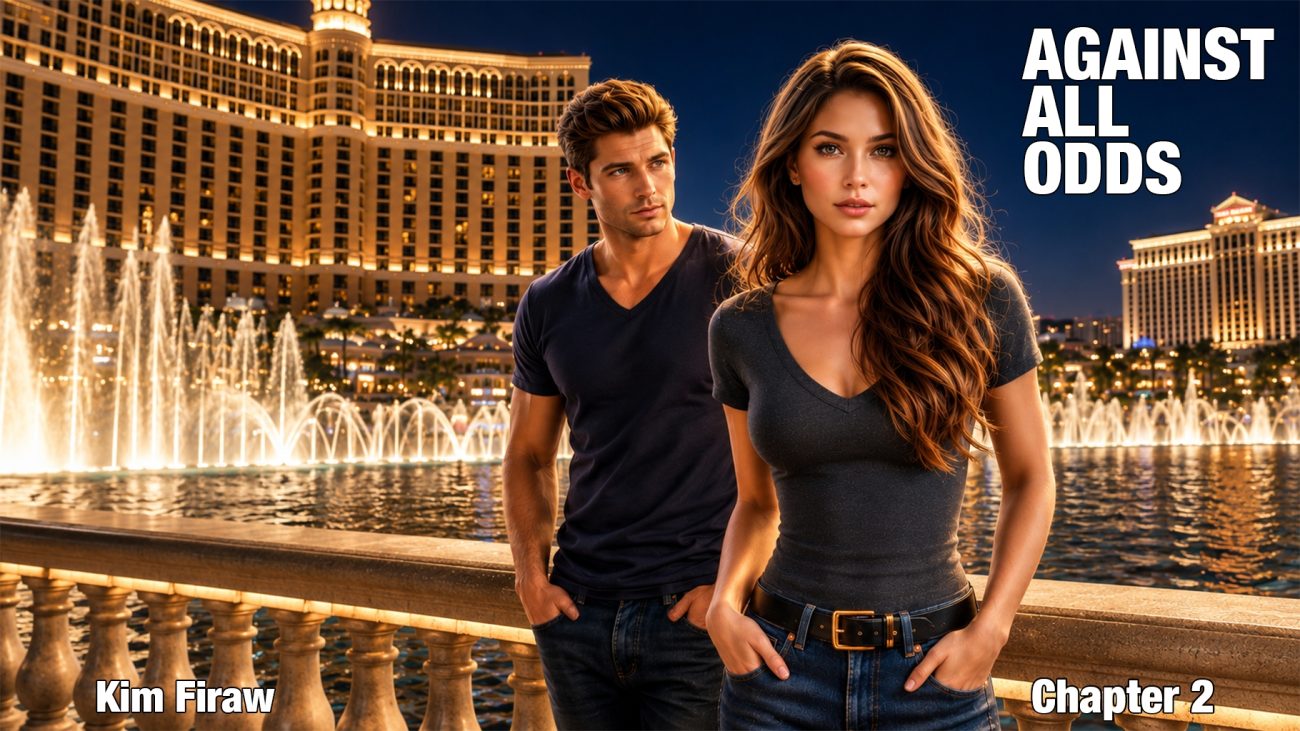
Previously – Chapter 1: Fateful Encounter
Level five of the Bellagio self-park held seven cars at six in the morning, and Jake Dalton had been sitting in one of them for fifty-one minutes with the engine off, nose out, facing the ramp, the way he parked everywhere.
Sixty thousand dollars was not a catastrophe, and he could argue it. Sixty was a good bar’s June, or the Silver Lake place from Memorial Day to the Fourth if the patio held. Sixty had a shape. It fit in your two hands.
Against that: sixty didn’t stand by itself. It went on top of what was already there, and what was already there had been a hundred and thirty-two when he walked into the house off Rampart at ten thirty last night in a shirt he’d had pressed for it. So the number this morning was a hundred and ninety-two thousand dollars. A hundred and ninety-two was weather.
The drive back was twelve minutes, and he could put the twelve in evidence: he’d made it six times in two days and timed it twice without meaning to. The game ran till eight, so two hours, and two hours was a session. Men had turned worse than sixty in that room in less time, with worse cards, in front of him, and he’d bought them a drink after.
He put his hand on the key and left it there.
Here was the argument: he had a meeting at eleven. Two men and a woman from a restaurant group in Newport Beach who’d flown in to look at his numbers, and if he went back in that house he’d come out at eight smelling like a house, and there was no version of that where he was the best thing that had happened to Vance Petrie all week.
So: discipline. You don’t play the day of a meeting.
He took his hand off the key and felt the small clean pleasure of a man doing the mature thing, and let himself have it.
An hour before that he had been standing in a kitchen.
It was a kitchen like any other kitchen in a stucco house off Rampart, and he took it in the order that mattered: one door to the yard, dead bolt thrown; the game two doors back, where the air conditioning was better; a wall calendar with a golden retriever on it and nothing written on any of the days. Nothing in the room was for anybody. That was the finding, and he let it stand. The kitchen was where Delia Cross did the paperwork, because Delia Cross did not do paperwork at a table where people were playing. She thought it was rude.
“Coffee,” she said. It was not a question and it was not an instruction.
“I’m all right.”
“Jake.” She was already pouring. Fifty-something, built like a woman who had once carried things for a living, in a cardigan the color of oatmeal. She poured it without hurry and without any visible interest in whether you liked it, and in eight years he had never worked out what she wanted. “You take it black. Sit down, you’re making me tired.”
He sat. The chair was a kitchen chair. There was a placemat.
“How’s your mother?”
“She had the hip done in March. She’s good.”
“Which one?”
“Left.”
“They’re better at the left,” Delia said. “I don’t know why that is. My sister had both and the right one still isn’t right.” She set the mug on the placemat and got the folder out of the drawer under the toaster, where she kept it next to the batteries and the takeout menus. “This is the boring part. I apologize for the boring part.”
The boring part took two minutes. He signed twice. She had a pen that wrote well. Almost nobody does.
“Your father used to sing at this table,” she said, capping it. “Not for anybody. He’d be waiting on a hand and he’d be out here with his back against that counter, singing to himself. Cole Porter, mostly. Flat as a board.”
“He was flat everywhere,” Jake said. “He was flat in the car.”
“He was very good company.” She said it the way you’d say a man was tall. Then she wrote a date on the outside of the folder and turned it so he could read it. “The end of the month’s no good for anybody. Everyone’s short at the end of the month and everyone’s proud about it.” She squared the folder to the edge of the placemat. “The fifteenth. That’s three weeks, and three weeks is me being sentimental.”
“The fifteenth.”
“If the fifteenth doesn’t happen, somebody has to come out to your places and be polite to you in front of your staff, and it takes all day and it’s nobody’s idea of a good time, mine least of all.” She put the pen back in the drawer. “I like your places. I sent my nephew to the one in Echo Park for his anniversary and he still talks about it. Mabel’s.”
“Named for my mother.”
“I know,” Delia said. “You told me that in February.”
He hadn’t remembered telling her. He stood up. “I’ll have it by the fifteenth. I promise.”
“Of course,” Delia said, and took his cup to the sink. Over the water she added, without any particular weight, “You can go back and sit down, you know. It runs till eight. Bobby’s still in and Bobby’s tired.”
“I’ve got a meeting.”
“Then you’ve got a meeting,” she said, and dried her hands.
Now he was on level five with a hundred and ninety-two thousand dollars, and the sun was doing the thing it does out here, where it doesn’t rise so much as get switched on.
He did not go back.
There was a hotel pen in the door pocket and a business card in his wallet with a number on it that went to an office phone nobody had answered since 2019. He turned the card over and wrote small, because he had a lot to say and one square inch to say it on.
Lila. For the record, I said four spins and it was three, and three is well inside the margin of error for a man who’d been talking to you for one minute and was not concentrating. Breakfast? Nine o’clock, the coffee place off the north lobby. Not the good one. The good one has excellent coffee and eggs like a hotel eraser. The bad one has bad coffee and a man named Hector on the flat-top who will make you the second-best breakfast of your life. If you’d rather sleep like a human being, sleep like a human being, and I’ll be the guy at the counter who was wrong about roulette.
J
The florist wouldn’t open for three hours, so he bought the rose off the overnight desk agent instead: out of the lobby arrangement, which was on contract, for twenty dollars and five minutes of conversation about the night shift. There’s a moment in a face, and he’d been watching for it since he was fifteen, standing behind his father in rooms his father shouldn’t have been in: the moment a person stops deciding what to say and starts deciding whether to say it. People will tell you it’s in the eyes. It isn’t in the eyes. What you notice is the jaw, a quarter of an inch, and the shoulders come down half a beat later like the second shoe.
Her name was Bernadette. She pulled the rose herself, from the back where it wouldn’t show, and wrote 1418, 8:00 AM on a sticky note in handwriting better than his.
At two minutes past nine Lila Brenner came in holding the rose by the middle of the stem like a woman who hadn’t been able to work out what else to do with it, and Jake, who’d had her at seventy-thirty to come, corrected the record: seventy-thirty had been the number he wanted, not the number he had.
She sat down. She looked at the room for about five seconds before she looked at him.
“Two servers,” she said.
“Two servers.”
“For a full floor.”
“For a full floor at nine on the last morning of a conference, when everybody checks out at eleven and wants their check in six minutes.” He turned his cup over so it wouldn’t get filled. “And the host stand’s empty, so they’re seating themselves, which means table seven’s a party of six in a two-top section, and Carla’s got twenty covers and Dmitri’s got three and a booth of grandmothers who’ll each want a separate bill.”
Lila set the rose on the table between them, and he stood it up in his water glass so it wouldn’t cook, and neither of them said one word about the rose at any point in the next hour. She looked at table seven for a while. “They lost that table.”
“Four minutes before you walked in.”
“They haven’t been greeted.”
“They have not been greeted, and now they’ve got their phones out, and once the phones are out you start the whole thing over like it’s a first date.” He tipped his chin at the pass. “Watch the busser, though. Hector’s running his own food because Carla’s buried, and he’s stacking three plates on his forearm and not dropping any, and nobody in this building will ever say a word to him about it.”
“How long have you been here?”
“Twenty minutes.”
“That’s disgusting,” Lila said. “I’d have needed twenty-five.”
Without appearing to notice she was doing it she squared the sugar caddy to the edge of the table, then the salt and pepper, then nudged the napkin dispenser a quarter turn so it faced the room instead of the wall, all of it in the middle of a sentence about the closing keynote. Jake had to look away and address himself to the window.
He got the black coffee and it was bad, and she got the eggs and they were not, and he had known which way it would go at the door.
“Second-best breakfast of my life,” she said, after.
“I don’t overpromise.” He moved the jam so she could put her elbows down, and she did. “What time’s your flight?”
“Four-forty.”
“And what happened with Curt?”
Her face did something interesting and he noticed every frame of it going by. She had a fast face. It went through irritation, then something colder and more accurate aimed at herself, then settled into dry, where she kept the good stuff.
“Curt sent two exclamation points.”
“Two.”
“Rain check!!“
“That’s a man who already told his wife he’s got a four o’clock.” Jake shook his head. “Okay. It won’t be Curt, Curt’s a tourist. When you do it again, don’t lead with the number.”
“I have to lead with the number. He’s giving me money.”
“Nobody gives anybody money at a first meeting. A first meeting is about whether he can repeat you to somebody else. He goes home, his partner says who’d you see today, and he has to answer in one sentence without sounding like an idiot. That’s the whole meeting. Make him build it himself and he’ll build it wrong and blame you for it.”
Lila had gone still, in the specific way of a person handed something they’d assumed they’d have to make themselves.
“Huh,” she said.
“Yeah.”
“No. Huh.” She picked up her fork and put it down. “Nobody’s ever,” she began, and stopped, and started a different sentence. He noticed the swap and did not touch it. “What’s the sentence, then. Hypothetically.”
“That’s your homework. I’ve got my own. Two men and a woman from Newport Beach in two hours and numbers that look like a ransom note.”
“Bad?”
“The downtown place is bad. Beautiful room in a neighborhood that was six months from happening for three straight years.” He said it easily, because it was true. “So I go in and I’m extremely charming at them, which is the part that works, and then a woman named Kate asks me one question about the third quarter that I don’t want to answer.”
“Do you know what the question is?”
“I always know what the question is. Knowing it doesn’t get you an answer, it gets you in the door standing up straight.”
Then table seven got up to leave, and Jake said “Hang on,” and went over. He did not stop them. He never blocks a guest. He stepped past them to the pass and said something short to Hector, and by the time the six of them reached the podium there was a woman coming at them with a coffee pot in each hand saying, “Sir, that’s on me, I sat you in the wrong section and I’ve been buried. Give me two minutes and I’ll have you fed and out by ten.” They sat back down. All six.
He came back and picked up his water.
Lila said, “You didn’t tell her what to say.”
“She knew what to say. She had a party of six she was about to lose and no way to get the words out, because she was one behind, and once you’re one behind you stop being able to hear yourself think. You just have to stand next to somebody for ten seconds.”
“And the busser?”
“Hector gets twenty on my way out and it isn’t enough, and he’ll say thank you, and it still won’t be enough. That’s the whole industry. I love it more than anything on earth.”
Lila was looking at him, straight on, chin down, and it went through him like a struck bell, and he had a second and a half to enjoy it before a woman arrived at the table in a conference lanyard carrying three pastries in a napkin.
“I have seven minutes,” the woman said, “and I have committed a crime.”
“Sophie,” said Lila, “this is Jake.”
“I know who this is.” Sophie Okafor sat down without being asked, set the pastries in the middle of the table like an offering to the gods, and shook his hand across the sugar caddy. Her grip was excellent. “You’re the roulette man.”
“That’s not the credit I’d have chosen.”
“You don’t get to choose it. That’s not how being described works.” She pulled a pastry out of the napkin and pointed the torn end at Lila. “The closing keynote is called Frictionless Arrival: The First Ninety Seconds. Ninety minutes. On ninety seconds. There’s a man up there with a slide of a door.”
“Is the door doing anything?”
“The door is emblematic.” Sophie ate a third of it in one motion. “I sent Theo a photograph of the door and he wrote back ‘is it a good door.'”
“Sophie’s husband,” Lila said, “is the calmest man in Illinois.”
“He’s asleep by nine-thirty every night of his life like a dairy farmer and I have accepted it.” Sophie turned the full apparatus on Jake. “So. Three bars. Which is the good one?”
“They’re all good. One’s beloved, which is different and mostly luck. Silver Lake, a room called the Bantam. The Echo Park one is Mabel’s, after my mother, and my mother has been twice and complained about the lighting both times.”
“She’s right, probably.”
“She’s right. It’s too dark, and it’s too dark on purpose. Turn it up ten percent and you can see everybody’s real face and the check average drops six dollars.” Sophie laughed the delighted laugh of a professional hearing a number she can use.
“How’s business?”
“Great,” Jake said.
He heard it go out of him, the speed of it and the flatness, and could not get up a defense against it: that’s the sound I actually make. It sat on the table for a quarter of a second. Sophie’s eyebrows didn’t move. But something behind her face made a note, the sort a good manager makes about a bar back, no judgment in it, just: filed, we’ll see.
Then she was off again. How he’d found the speakeasy, whether the doorman there was salaried or hourly. And then, leaning in, serious: what he did when a regular’s card declined in front of a date.
“You run it again,” Jake said.
“It’s going to decline again.”
“It’s going to decline again. Doesn’t matter. You take it back to the terminal, you take your time, you come back and say the terminal’s being an animal tonight, we’ve had it all week, catch you next time. Then you never mention it and neither does he, and that man is yours until he dies.” He put a sugar packet back in the caddy Lila had squared. “Sixty dollars. Cheapest thing on the menu.”
“That’s a good answer.”
“I stole that from my father.”
“Then he was good,” Sophie said, gathering her remaining crimes into the napkin. She was halfway to standing when she stopped and pointed at the check folder with Jake’s card already in it, because he’d handed it to Carla at ten past eight, before anyone had ordered anything.
“You pre-paid.”
“I got here early.”
Sophie said, “No, you,” and stopped with her mouth open on the rest of it, and closed it. She looked at the folder, then at him, and there was a thing happening on her face he recognized, because he’d seen it on a thousand faces across a hundred bars: somebody who has caught the smell of something, can’t find the source, and is going to be mildly unhappy for a day without knowing why.
“Nothing. Never mind. It’ll come to me at two in the morning and I’ll wake Theo up about it.” She kissed Lila on the top of the head. “Four-forty. Don’t be a hero, security’s a nightmare today.” And she went off toward the ninety-minute door.
“She liked you,” Lila said.
“She’s not sure she liked me.”
“No, she’s sure. She’s going to be annoyed about it for a while. She’s right about people ninety percent of the time and she can never tell you why, so you take her on faith, like a barometer.”
“What’s the ten percent?”
“Theo. She thought he was boring for eight months.”
She ate the last third of Sophie’s abandoned pastry off the napkin. Then she took his hand off the table and turned it over and looked at the palm of it the way you look at something you are going to have to describe to somebody later, and put it back where she had found it, and said she had to go pack.
The meeting was at eleven in a windowless salon with eighteen chairs for four people. Vance Petrie talked for six minutes about a wine bar he’d owned in 1988. The son-in-law said nothing. Kate Hoefling, who had two colors of tab flags in the Dalton & Sons P&Ls, asked her question at 11:26.
“Your owner draws. Last year, second half. Sixty-one thousand in July, forty in August, then nothing in September or October. That’s a lot of variance for a fixed draw.”
“It’s not a fixed draw,” Jake said. “I take what’s there after payroll and I don’t take it when it isn’t, which is why September and October are zeros. September’s rent-and-insurance month for all three. If I’d drawn in September I’d have had to make a phone call in October, and I don’t make that phone call.” He said it with his hands open on the table. Every word of it was true. It had been true for twelve years and had stopped being true in the spring, and the sentence had not changed.
Kate Hoefling wrote something in the margin.
At 11:50 Petrie said they loved the story, they really did, and they’d want the downtown lease restructured and twelve clean months on the consolidated, and let’s talk in the spring. Jake said absolutely, and meant it, and walked out and stood in the hall.
Twelve clean months. Fine. That meant restructuring downtown, and restructuring downtown meant about ninety to buy out of the escalator. Ninety had a shape. It was less than half of a hundred and ninety-two. So: this had never been a debt problem at all. It was a sequencing problem, and he ruled on it standing up in a hallway in under a minute.
He was standing outside the salon smiling at a fire extinguisher.
He texted her at 12:04. How attached are you to four-forty
Professionally or spiritually
Either. Both. Stay till Friday.
There was a long gap. He spent it walking the length of the mezzanine twice.
He wanted her to stay. She had looked at a dining room for five seconds before she looked at him. When he’d said the thing about the one sentence she’d gone still, and he had put that stillness there, and nobody had ever let him do that without wanting something afterward. At some point that morning he had stopped running the odds on her, and he had never once stopped running the odds on anybody.
And if she stayed, he’d be in this city until Friday, and the house off Rampart. He didn’t finish the thought. He was good at not finishing it.
He put the phone in his pocket and bought a coffee he didn’t want, and when he took the phone back out she had written Friday, and then, a second later, I’ve never done that in my life, and he stood in the middle of a hallway and laughed out loud like a lunatic.
He took her to a strip mall on Spring Mountain at eleven at night, which is what you do if you know the town. Fluorescent lights, a laminated menu, a second menu on the wall in Thai that was the real one, one door in and a kitchen door out back. The room was people who’d come off shift in the last half hour, two dealers still in their vests, a woman in the black-and-whites with her shoes off under the table, and not one of them performing for anybody, which was the whole argument for the place and the reason he had settled on it three days out.
Lila looked around and said, “Oh. This is where everyone is.”
“This is where everyone is.”
“That man’s eating with his lanyard on.”
“Floor supervisor. He’s back on the floor in ten minutes, don’t judge him.” He translated the wall menu, badly and confidently. “Order the thing that scares you.”
She ordered the thing that scared her. Four bites in her eyes went, and she did not stop, and she put a hand out flat on the table without looking up, and he put his beer into it.
They ate for an hour. She was funnier than he was and didn’t seem to know it. She told a story about a guest at the Warrick who wanted a cardiologist at two in the morning, flat and fast, with a devastating impression of the cardiologist, and by the end the woman with her shoes off had turned all the way around in her chair.
Then Lila put her chin on her hand and said, “Tell me about your father.”
So he told them about 1994.
“Nineteen ninety-four,” he said. “Atlantic City. Big Mike Dalton is in Atlantic City in September of 1994 for one reason, which is that his brother-in-law’s wedding got called off eleven days out and the room was nonrefundable. That’s it. A man he didn’t like didn’t marry a woman he’d never met, and there’s a room.”
“How much did he go with?”
“Six hundred dollars,” Jake said, “and a rented tuxedo.”
“Rented for the wedding.”
“Rented for the wedding and canceled with the wedding, and my father drove to the shop in Bayonne and paid for it anyway, because if you’re going to go, you go correct. He explained this to me perhaps a thousand times.” The next table was listening now. He could feel it on the side of his face and he did not look over, because you never look over. “So. Tuxedo. Atlantic City. Alone. And he doesn’t even play craps. He never played craps, he didn’t know the layout. He’s at the rail because there’s a woman shooting who’s been shooting a while and there’s a noise coming off that table you can hear from the carpet.”
“And he pressed her line.”
“He pressed her line.” Jake spread his hands. “Six hundred dollars on a stranger, and she did not seven out for one hour and forty minutes. My father stood there in a tuxedo he’d paid for out of spite and came off that table at three-fifteen in the morning with two hundred and fourteen thousand dollars.”
The woman with her shoes off said, “Shut up.“
“Two hundred and fourteen thousand, in 1994. And I want to tell you exactly what he did with it, because this is my favorite part. He bought a Cadillac. He bought a boat.”
“How big a boat?”
“Nobody knows. That thing never got wet, not one time, not with a Dalton anywhere near it. It sat in my uncle’s side yard for six years under a blue tarp and then it didn’t.” He was building it now, and he knew he was building it, and the whole room was leaning. “And he gave the rest away in ten months. Not gambled. Gave. My cousin’s community college. Somebody’s transmission. Two months of rent for a guy he’d met the previous Tuesday. Ten months, all of it, gone. And here’s the actual thing: he told that story every day for the next twenty-nine years. At every dinner. To every stranger in every bar he ever owned, and he owned four and he lost four, and if you’d asked him on the last day of his life whether he was up or down, he’d have looked at you like you were slow and said up.”
They were all laughing. He was laughing. Lila laughed in the wrong places, early, at the tuxedo, and not at all at the boat, and when he came off the top of the story he found her with her chin on her hand watching him, and he lost his place for a second in something he had told four hundred times.
“And at the funeral, three different people told me that story. Told it back to me. Like I’d never heard it. And one of them got it wrong.” He picked up his beer. “He said Big Mike shot the dice himself.”
“And you corrected him,” said Lila.
“I corrected him,” Jake said, “at the funeral, at some length, in front of a priest,” and the woman at the next table put her head down on her arms.
They walked afterward, because you have to walk after that food, and because he did not want the night to end and had run out of ways to say so that weren’t asking. She put her arm through his somewhere in the second block, with no ceremony, the way you pick up a thing you had put down. They ended up at the lake in front of the Bellagio at twenty past midnight, which is twenty minutes after the fountains stop.
“They’re off,” Lila said.
“They’re off at midnight.”
She considered it, hands in her jacket pockets, looking out at eight and a half acres of flat black water with the hotel lights lying on it in long unbroken stripes. “That’s better.”
“It’s much better. Everybody stands here at nine and gets Sinatra’d at. Nobody stands here now.” Under the surface the pipes made a low sound, some enormous plumbing turning over in its sleep. “You can hear it thinking.”
“You didn’t kiss me last night.”
He turned his head. “No.”
“Was that a technique?”
She was standing there with her chin up, waiting, no expression on her face: the same face she’d worn at the roulette table when she called it, the face of somebody who has already done the math and is checking your work.
“Yes,” he said.
“I knew it.”
“It wasn’t a strategy.”
“You said technique.”
“You said technique, I only agreed with you, which is completely” was as far as Jake got, because she had a fistful of his jacket, and she pulled, and he came, and neither of them said anything else for a while, in front of eight and a half acres of stopped water.
The room was hers, on fourteen, and he had the rose in the water glass and the open garment bag before the door had shut, plus six other things nobody needed. He had stopped arguing with himself about that years ago.
He talked. God, he talked. He got the ice bucket. He said something funny about the artwork over the bed, something funny about the minibar, something genuinely funny about hotel duvet covers as a category, and he was three sentences into an anecdote about a linen supplier in Van Nuys when Lila took the ice bucket out of his hands and set it on the desk.
“Hey,” she said. “You can stop.”
“Stop what?”
“The show.”
It landed under his ribs and did no damage, which he checked for twice before he would believe it.
“That’s just what I’m like.”
“It’s a very good personality.” She reached up and took his collar in two fingers and straightened it. “I’ve had it for thirty hours. I’d like the other one.”
“There isn’t another one.”
“Okay,” she said, agreeably, and did not believe him, and kissed him anyway.
Later he went for the lamp on the desk, lightly, with a joke ready in his mouth, and she reached past him and put the one by the bed back on and left it on.
There is a moment where you are out of moves. He’d had it maybe five times in his life, and three of them were at tables. It isn’t panic. Everything gets quiet and you can hear the air conditioning and your own pulse, and you are out of things to do with your hands.
She looked at him and kept looking. She was above him with her hair down and one hand flat on his chest and she held it, the looking, past the point where anybody holds it, past four or five junctures at which he would ordinarily have said something excellent.
He turned his face into her shoulder, which is the oldest trick there is. She put her hand on the back of his neck and left it there and did not let him leave, and after a while he came back up and let her look, and he was shaking slightly and she did not comment on that either.
“Don’t be careful with me,” she said, at some point.
“I won’t. I promise.”
Afterward the air conditioner cycled off and the whole building got four degrees warmer at once.
“You’ve asked me about sixty questions since yesterday,” Lila said. She was on her stomach with her cheek on her forearm and one foot hooked over his ankle, and she sounded two minutes from gone.
“You’re interesting.”
“That is not what I said.”
He looked at the ceiling and gave himself thirty seconds of not taking inventory of it, and lost, and the water stain in the corner nearest the bathroom was going to be somebody’s problem inside a year.
“When I was a kid I used to answer our phone in my father’s voice. Not as a joke. I got good at it. I could do the throat thing he did.” He kept looking at the ceiling. “Because if I picked up as me, they’d ask for him, and I’d have to go get him and hand him the phone and watch his face. But if I picked up as him, whoever it was would just start talking, and I’d hear how bad it was before he did.”
Lila was quiet for a moment.
“How old?”
“Nine? Ten.”
“Jake.”
“Don’t make it a sad story. I was excellent at it. It’s a talent.”
She moved her hand across the sheet and found his forearm and put two fingers on the inside of his wrist, as if taking a pulse, and left them there, and said nothing else about it, and a minute later her breathing changed and she was out.
At three he got up for the ice he’d never gotten. She had worked her way out from under the sheet somehow, one shoulder and most of an arm, and he put it back over her, and she made a small sound with no words in it, and he stood there another second with his hand on the sheet before he went.
The machine was in an alcove past the elevators under a light that buzzed, and it dumped a load into the bucket with a noise like a small building coming down, and then the hall was quiet again with the specific quiet of a hotel hall at three in the morning, the carpet eating everything, a television two doors down at a volume just below language.
He stood there in his jeans with the bucket sweating against his hip and got out his phone.
The contact said DELIA C and nothing else, no last name, because he’d entered it eight years ago in a parking lot in Henderson and had felt clever about it.
He pressed delete. The phone asked if he was sure. He said he was sure, which made two mature things inside of twenty-four hours, and he took the credit for both before the screen had gone dark.
Then he took the pen out of his jacket pocket. The hotel one, blue, from the car. And he wrote the number on the inside of his left wrist, small, in the soft place where the veins are, the way you’d write down anything you couldn’t afford to lose.
He capped the pen. He picked up the bucket. He went back down the hall.

2 thoughts on “Against All Odds – Chapter 2: What He Wrote on His Wrist”