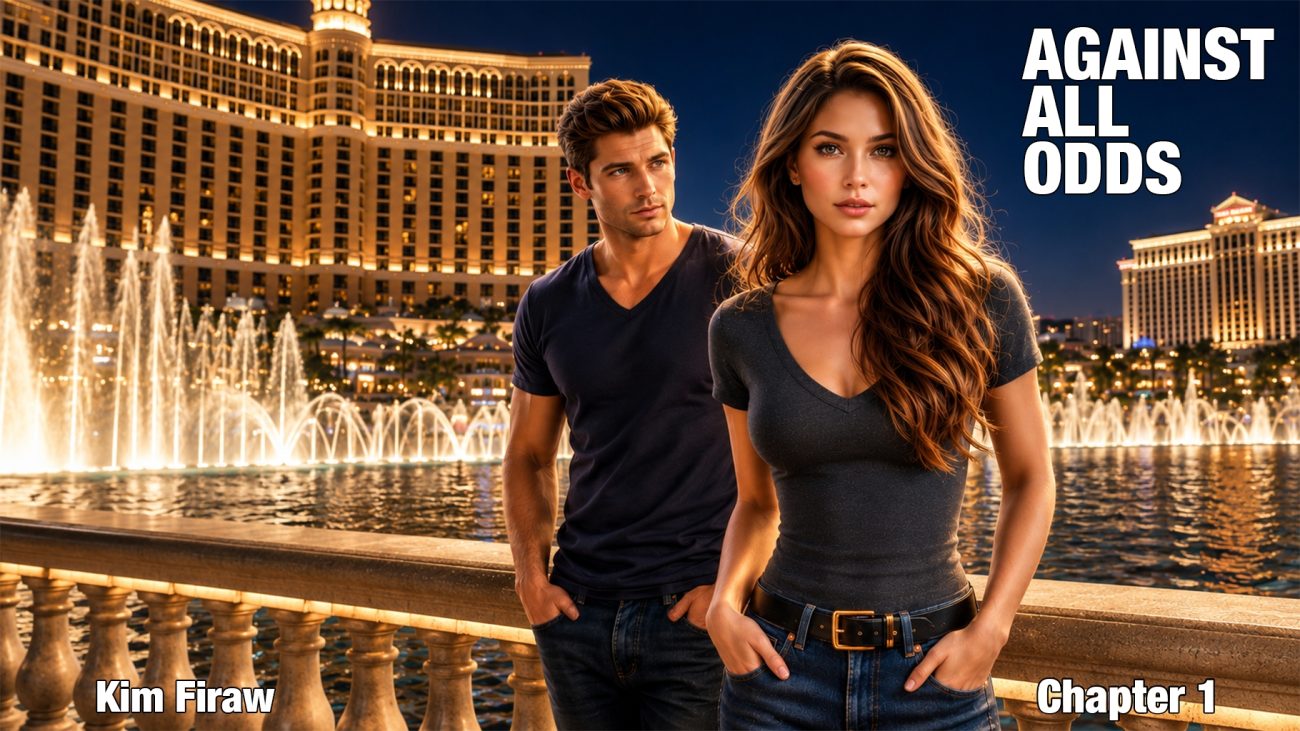
The text came in at 3:52, eight minutes before the meeting, which meant Curt Reisman had known since roughly ten that morning and had spent six hours deciding how to phrase it.
rain check!! traveling, totally my fault. let’s find time
Two exclamation points. Lila Brenner read it twice. Nobody puts two exclamation points on a thing he feels bad about.
She was standing in the Bellagio conservatory when it arrived, half an hour early, because she was always half an hour early, in a dress she had bought in April for a meeting in July.
Above her hung the summer display: eight thousand stems of something orange, a koi pond with actual koi in it, a life-size horse assembled out of marigolds. Lila did the arithmetic without deciding to. Six horticulturists on nights, probably eight. A three-hour changeover between the last drunk and the first coffee. Somebody in a warehouse in North Las Vegas whose entire professional existence was chilled peonies.
She typed: Of course. I’ll follow up next week.
She deleted it.
She typed: No problem at all! and looked at the exclamation point for a while, because there was a version of this in which she was the kind of woman who matched a man’s punctuation, and she did not want to meet her.
In the end she sent: Understood. Safe travels.
Nobody knew where she was supposed to be at four o’clock. Not the Warrick, which had approved three days of the Independent Hospitality Association conference and a per diem of ninety-one dollars a day. Not her mother. Not Sophie, who had been her closest friend for nine years and knew there was a meeting and not what it was for, because Sophie would have been thrilled, and thrilled was a thing you then had to live up to.
Six years of night shifts and one document, forty pages long, eleven revisions deep, that no living person had read. There was a number in it she had said out loud once, alone, standing in her own kitchen with the fridge running, to hear what it sounded like coming out of her mouth.
She could have gone up to the room. Instead she took the long way around the lobby, under the Chihuly, past the concierge desk, and there she made the evening’s first mistake. She stopped walking.
A woman in her sixties, cardigan over a sundress, was explaining a cake.
“It’s just that it’s his birthday,” she said, for what had to be the third time, in the manner of a person who believes the obstacle is that she has not yet been understood.
“I completely understand, ma’am. Our pastry boutique closes at four.”
Lila stood six feet away and read the desk. Twenty-three, maybe twenty-four. Name tag so new the engraving still had a shine on it. He had his hands flat on the marble, the way they taught you, and his eyes on the screen, the way they taught you not to.
She was not on shift. She was, if anything, professionally on another continent.
“Sorry,” she said. “Excuse me. I’m being rude.”
The woman turned. So did the boy behind the desk, with the particular flat expression of someone who has decided that whatever happens next is going to be worse.
“Call room service,” Lila said. “Not the bakery. Ask for the pastry kitchen. The kitchen, not the boutique; they’re different departments and they don’t like each other. Use the word amenity. And get a name before you hang up.”
“A name,” the woman said.
“Any name. Once you have a name it isn’t a hotel anymore.”
The woman wrote amenity on the back of a room key sleeve, thanked her with a startling amount of warmth, and left at speed.
Lila turned back to the desk. “You did the right thing, for the record. She’s going to go upstairs and tell that story with you in it and you’ll come off badly and it will be unfair.”
He said nothing.
“Nine times out of ten,” she said, “the kitchen will do it for the cost of a room service dessert plus fifty. If you call it in yourself, from this phone, right now, while she’s still in the elevator: she tells that story for a year and you’re the hero of it. Costs the property nothing.”
He looked at her for a second.
“Are you a manager?”
“No,” Lila said. “I’m on vacation.”
* * *
Lily Bar sat at the edge of the casino floor like a stage box, three steps up above everyone losing money.
She ordered a gin martini, stirred, lemon, and it arrived in a coupe with a bowl the size of a grapefruit, filled to within a millimeter of the rim, so that lifting it was a dexterity test. She lifted it. A quantity of it went onto the bar.
“Sorry,” she said.
The bartender wiped it down without looking at her. That was correct.
While she waited for the glass to become physically possible, she squared the stack of cocktail napkins to the rail and turned the tent card advertising a cocktail with edible glitter in it so that it faced the room, and did not notice doing either.
There were twelve people working this bar. She had not counted, exactly. They had registered on her anyway, like a smoke alarm chirping in another room. Twelve, and eight guests in the room, three of whom were drinking water, on a Tuesday at twenty to ten at night.
That was how she came to be looking at the casino floor instead, and at the roulette table nearest the rail, where a man in a blue shirt had been standing since before she arrived.
Fifty, maybe. No jacket. Sleeves pushed up unevenly, one higher than the other. That happens to a shirt over hours, not all at once. His phone lay face down on the padded rail.
He had stopped tipping the dealer. That was the first thing. He had green chips in front of him and he was no longer putting one out for the house, and a man who tips at the start of a night and stops in the middle is not being cheap. He is running out of the version of himself that tips.
And he had stopped watching the wheel. He watched the dealer’s hands. He watched the marker come down. He had quit looking at the part of it that was still undecided.
“He’s going to lose all of it,” Lila said.
Out loud. To nobody. She did that more than she liked.
“Four spins,” said the man two stools down.
She looked over. He was not looking at her; he was looking at the table, with his chin slightly up, as though at a departures board. Good jacket, no tie, a shirt that had been on since seven that morning. In front of him was a rocks glass on a napkin, and the napkin was dry, and there were no rings on it.
“Four,” she said.
“Give or take.”
First spin: the man in the blue shirt put seventy-five out across three numbers, and the ball came up five, and the dealer swept it.
Second spin: he did exactly the same thing, in exactly the same places, which was its own kind of statement, and the ball came up twenty-two, and the dealer swept that too.
Third spin: he stood up.
Lila had watched a great many people stand up in her life. Out of chairs at the end of dinners that had gone badly, off lobby sofas after phone calls, out of banquet seats halfway through a toast.
He pushed everything he had left out onto the layout in a shape that was less a bet than a gesture. The wheel turned. It took about six seconds.
He said something to the dealer, and the dealer said something kind back, and he picked his phone up off the rail and put it in his pocket and walked off toward the sportsbook without hurrying.
Beside her, the man two stools down set his glass down on the dry napkin.
“Well,” he said. “Nobody’s perfect.”
* * *
“You were closer than me,” Lila said.
“I was one off.”
“You had a number. I had a mood.”
He turned on the stool. Up close, he had one of those faces that had been getting people to relax for a long time and knew it. “How’d you get there? The mood.”
“He stopped tipping.”
He made a small sound, like something had been confirmed.
“And you?” she said.
“Six hundred in green. He’d been going seventy-five a spin for about an hour. So: two more losses, then one small hit, and the small hit convinces him, and then he gives it all back at once.” He shrugged. “Four. He skipped the part where he gets encouraged.”
“That’s the sad part.”
“Which part.”
“He didn’t even get the good part,” Lila said. “He went straight from bad to over. Nobody got to feel anything.”
He was quiet for a second. “No,” he said. “He didn’t.”
She drank some of her enormous martini.
“Can I ask you something,” he said. “Do you know how many people are working this bar?”
“Twelve.”
She had said it before deciding to say it.
“Twelve,” he repeated.
“Thirteen if you count the girl at the podium, but she won’t be on this cost center.”
He put both hands flat on the bar. “For a Tuesday.”
“For a Tuesday, at twenty to ten, with eight guests in the room, three of whom are drinking water. So they’re carrying about five hundred an hour in labor to sell, what, a dozen covers? They’re not making a mistake, though. That’s a corporate headcount that got set in March and nobody’s allowed to touch it until the quarter turns.”
“You’re industry.”
“Is it that obvious.”
“You counted the staff.”
“I didn’t count,” Lila said. “I noticed. Counting is when you have to look twice.”
He laughed at that, properly, which was more satisfying than she wanted it to be.
“The music’s up four clicks from when I sat down,” he said.
“Nobody ever turns music down. It’s a ratchet. It only goes one direction, all night, until eleven, when a manager walks through and hates it and drops it twelve clicks and everyone in the room thinks the power’s gone out.”
“The barback’s polishing in the window.”
Lila closed her eyes briefly. “Don’t.”
“Glass after glass, right there in the guest sightline, holding them up to the light.”
“Don’t.“
“Like a man doing surveillance on his own inventory.”
“We fired someone for that,” she said. “Not for that. But it came up.”
He put a hand out. “Jake.”
“Lila Brenner. Senior concierge, the Warrick, Chicago.” She heard it as it left her. Three days of a lanyard had gotten into her voice. “God.”
He didn’t laugh at her.
“Dalton,” he said.
“That’s a bar name.”
“It is a bar name. Three of them. Los Angeles. Dalton and Sons.”
“Sons.”
“There’s just me.” He picked his glass up, and put it back down without drinking from it. “The Warrick. You do your own laundry.”
“Everyone thinks that’s a fun fact.”
“It is a fun fact. It’s deranged. Nobody does their own laundry.”
“We have six presses in a basement on Superior Street and a man named Aurelio who has strong feelings about all of them.”
“That’s the whole hotel though,” Jake said. “That’s why it’s good. Somebody twenty years ago did the math on outsourcing it and came out eleven cents ahead and said no anyway.”
It was right, and nobody outside the building had ever said it to her.
* * *
“There’s a bar,” he said, twenty minutes later.
“There are nine hundred bars.”
“There’s a bar about twenty minutes from here where the ice is cut to order and the room is kept at sixty-five degrees on purpose.”
“Sixty-five.”
“So nobody sweats,” he said, “and nobody stays for six drinks.”
“So somebody built a bar to prove a point.”
“It’s twenty minutes. It’s worth it, I promise.”
She had a system for this. She had built it for other people; she had given some version of it to a hundred guests over six years, usually women, usually quietly, at the desk, with the printed map turned around so it looked like she was giving directions. She ran it on herself now.
She looked at his shoes.
They were good shoes and they had been resoled at least twice. A man buys shoes like that when he has money. He resoles them twice when he has taste, or when he doesn’t have money anymore, and she could not tell which, and she wanted to know.
“I’m going to send my friend a photograph of the door,” she said.
“That’s smart.”
“I wasn’t asking.”
“I know,” Jake said. “I’m complimenting you.”
On the way out through the casino, a man in a maroon vest standing at a service corridor door said, “Mr. Dalton,” and Jake said, “Ronnie, how’s the knee,” and Ronnie said the knee was a disgrace, and that was that.
* * *
The place was on Spring Mountain Road, past the Chinatown gate, in a strip mall with a mahjong parlor at one end and an all-night bakery at the other whose case, at that hour, held three pandan rolls and a lot of empty stainless.
The door was around the side, next to the dumpster corral, painted the same beige as the stucco, with a brass plate on it that read GRACE & SON MONUMENTS.
“Monuments,” Lila said.
“Headstone company. Went under in about 2011. Nobody ever took the plate off, so now that’s what the place is called, which drives the owners insane, because they picked out a real name and paid a person for it.”
A man was sitting on a folding chair beside the door with a box fan aimed at his face and a paperback western folded backward in one hand. Sixties. Slippers, actual slippers.
“Gus,” Jake said.
“Hey.” Gus did not get up. “You bring somebody.”
“I brought somebody.”
“How’s Denise doing at school? She like it?”
“She hates it,” Gus said, with enormous satisfaction. “Says the dorm’s too loud. Eighteen years I couldn’t get that girl to sleep and now she wants quiet.”
Lila took a photograph of the beige door and sent it to Sophie. If I’m murdered, this is the door.
The reply came before she’d put the phone away.
Sophie: that is a DUMPSTER with a door leaning on it for moral support
Sophie: also why are you in chinatown, your thing was at four
Lila looked at that for a second longer than she needed to.
Ran long, she typed, and put the phone in her bag.
* * *
Inside was a hallway with a rubber runner and a smell of bleach and cold stone, and then a heavy felt curtain, and then the room.
Twelve stools. Three tables. The ceiling low enough that a tall man would spend a moment thinking about it. The walls were the color of a manila envelope, and all the light came from below: small lamps set down at bottle height, so that every face in the room was lit the way a face is lit by a birthday cake.
It was cold. Deliberately cold. She was in a sleeveless dress and she felt it along her arms and did not mind.
There was no music at all for the first minute and a half. Then there was, and the bartender put it on himself. A record, out of a paper sleeve, handled by the edges. Then he went back behind the bar and started cutting ice.
He had a block of it on a board and a saw. An actual saw. He cut a piece off the block, squared the piece, squared it again, and dropped it into a glass, and did the whole thing in the time it took Lila to sit down and put her bag on the hook under the bar that she had not expected to find and did find.
There was ice dust on the board, like sawdust.
Her hands went out along the bar in front of her and found nothing to do. The napkins were square. The stools were in. The bottles on the back bar were faced. Somebody had already been here.
Her brain did what it did instead.
Twelve stools. Say a two-drink average and ninety minutes a turn, three turns on a strong night, call it eighteen dollars of margin a head if they were disciplined about the pour, and somebody back there was being paid an hourly wage to operate a saw. There were maybe thirty bottles on the back bar, and the entire point of thirty bottles was that somebody had thrown away three hundred.
“This doesn’t work,” she said.
“No.”
“Financially. It can’t. Who’s paying for it?”
“The guy who owns the mahjong place owns the whole strip,” Jake said. “His wife likes the bar.”
“That’s the answer to every good bar in America.”
“That’s the answer to every good anything.”
There was no register anywhere in the room. When the man two seats down settled up, the bartender wrote something in a composition notebook with a pen he kept behind his ear, took cash, and made change out of a wooden drawer.
And nobody in the place was on a phone. There was no sign about it and nobody had asked. Lila had spent six years in rooms designed to get people to put their phones down, rooms with fireplaces and no clocks and a lighting consultant flown in from Copenhagen, and she felt something adjacent to spite at how easily this one had managed it, for free, next to a dumpster.
Jake ordered two daiquiris, and then said, to her, without any performance in it: “I’m not ordering for you. I’m ordering for them.”
“Go on.”
“Three ingredients. Nowhere to hide. If they can make a daiquiri you know everything about the room in one sip, and if they can’t, you’ve learned it for eleven dollars.” He tipped his head. “You’re going to like it. I promise.”
The drinks came in glasses barely bigger than egg cups, frosted white all the way down, no garnish, no straw, no story. She drank hers. It was cold in a way that a drink is only cold when a person thought about that glass an hour ago and put it somewhere.
She set it down and did not say anything for a moment.
“Yeah,” Jake said.
“I didn’t say anything.”
“That’s what I mean.”
Somewhere in there he had taken his jacket off and hung it on the hook under the bar next to her bag, and had not offered it to her, and had not looked at her while he did it. Twenty minutes later she was wearing it and could not have said when that had happened.
* * *
“So what happened at four o’clock,” he said.
“Excuse me?”
“You said you’re here for the conference. Nobody dresses like that for a breakout session on RevPAR.”
Lila turned the tiny glass a quarter turn on the bar. “I got stood up,” she said, “by a man named Curt,” and delivered it as a joke, with the shrug at the end.
Jake didn’t laugh. He waited. She talked anyway.
“It was a pitch,” she said.
“For what?”
“Events. Weddings, product launches, corporate stuff nobody enjoys. My own shop.” The sentence still felt like a coat that hadn’t been let out. “I’ve never said that in a bar before.”
He turned his stool so that he was facing her instead of the bar, which almost no one does.
“How much were you asking him for?”
“Two-fifty.”
“For.”
“Deposits, mostly. A van. Insurance, which is worse than everyone thinks. One full-time hire. A real one, not an intern, because interns can’t be at a loading dock at five a.m. Eighteen months of runway so I’m not making decisions out of fear. And the float.”
“What’s the float?”
Lila answered without pausing, because the number lived in her the way a phone number lives in you.
“On a three-hundred-person event, I’m carrying about sixty-two thousand for roughly forty days. Rentals want fifty percent at signing. The band wants all of it. Florals want everything up front because florals get burned constantly. And the client pays me thirty days after the event, which means I’m funding their party with my money for six weeks and smiling about it. If it’s in a hotel, it’s ninety days, because hotels pay when they feel like it.”
He looked at her.
“That’s your first sentence,” he said.
“That’s a plumbing diagram.”
“That’s the only sentence in the whole pitch that proves you’ve already done the job.”
“It’s bookkeeping.”
“It’s the job.” He put the glass down. “Everybody who walks into that man’s office can tell him what the business is going to be. Anybody can do vision. You just told me, from memory, at midnight, slightly drunk, what it costs to be it. With the hotel penalty built in, which he will not have thought of once in his life.”
“So I open with a working capital number.”
“You open with sixty-two thousand and forty days. Then he spends the rest of the meeting trying to catch up with you.” Jake shrugged. “People write checks when they feel like they’re behind.”
Lila’s hand had moved, at some point, toward her bag.
There were forty pages in there. Not in the bag. On the laptop, upstairs, in the room, with a two-page appendix on vendor payment terms that said almost what she had said out loud, in a sentence she had rewritten six times and had never once considered putting first.
She put her hand back on the bar.
“He also didn’t cancel because he lost interest,” Jake said.
“He said he was traveling.”
“Four o’clock on the third day of a conference is the slot you give somebody as a favor. It’s the leftover. He gave you the leftover and then something real came up and the leftover went in the trash, which is what leftovers are for.” He said it without any heat. “Don’t take the favor slot again. Take nine a.m. Nobody’s canceled a nine a.m. in the history of Las Vegas, because at that hour nothing better exists yet.”
“You’ve thought about this.”
“I’ve been the guy asking for money,” Jake said, “a number of times.”
“And?”
He smiled and asked her how she’d gotten into hotels in the first place, and she told him. The summer job at nineteen that was supposed to be a summer job. And then she told him about the night the actor’s dog got loose in the ballroom during a rehearsal dinner, and about Aurelio and the presses, and about a guest who had once asked her, sincerely, to make it stop raining.
She talked for a long time. He asked the second question, and then the third one.
* * *
On the way out, Gus had his chair tipped back against the stucco and the paperback closed over one thumb.
“Take care of her,” he said to Jake. And to Lila: “He’s all right.”
“That’s a low bar.”
“It’s Las Vegas,” Gus said, and went back to his book.
The cab put them out at the north end of the block because something at the south end was closed for a film crew, and so they walked. It was two in the morning and eighty-six degrees, and the Strip smelled like chlorine and cigarettes and the sugar that came off the frozen drink machines and got into everything. She gave him his jacket back on the sidewalk. Neither of them mentioned the jacket at any point in its entire history.
Men with flyer cards snapped them against their palms in a rhythm, a dry insect sound, all the way down the block. Outside a steakhouse that had closed an hour earlier, a doorman was folding a velvet rope over his arm, and he looked up and said, “Evening, Mr. Dalton,” and Jake said, “Evening, Paul. Tell your mother I said hello,” and Paul said he would.
Lila got another twenty feet before she asked.
“How many doormen do you know in this city?”
“All of them.”
“Seriously.”
“Seriously? Most of them.” He put two fingers on her elbow and brought her around a puddle of something that had no business being on a sidewalk in July, and took them away again immediately, and she noticed both halves of that. “It’s the job, though. You want a table anywhere in America at nine on a Saturday, you don’t need the chef. You need the guy at the door, and you need to have known him for two years before you need him.”
On the pedestrian bridge a bachelorette party had stalled out: three of them, two upright, one crying, all of them barefoot with their shoes hooked over their fingers.
“That one’s fine,” Lila said. “Watch. The one on the left brought water.”
“You can’t know that.”
“She’s got a tote. Nobody carries a tote to a club unless she has decided she’s in charge of everybody.”
The woman on the left produced, from the tote, a bottle of water and a granola bar, and Jake said, “Okay,” in a tone Lila liked, and they kept walking. He was quiet for most of the next block, and when she looked over he was smiling at the sidewalk about something he did not appear to have any intention of sharing.
They came around to the front and the fountains were done for the night. The lake sat there flat and black, eight and a half acres of it, with the whole hotel doubled upside down in it and not moving.
Out in the middle of it, a man in a small flat boat with a light strapped to his hat was going slowly along, taking things off the surface with a net on a pole.
They stopped at the rail.
“That’s my favorite thing in Las Vegas,” Jake said.
“The third shift.”
“The guy.”
“There’s a guy for everything.” Lila leaned on the rail. “There’s a guy who resets the roulette layouts. There’s a woman in that building right now steaming four hundred napkins for a plated lunch tomorrow, and if she does it right, nobody will ever learn her name, and if she does it wrong she’s the only thing anybody talks about all day.”
Jake said, “You’re describing your entire career.”
“I’m describing the industry.”
“Sure,” he said.
Their forearms were side by side on the rail, an inch apart, and had been for a while, and Lila found that she knew the exact size of the inch.
The man in the boat went past a submerged fountain nozzle and reached over and picked something out of the water and dropped it in the bottom of the boat, and never once looked up at the two of them.
* * *
He walked her in through the doors, past the flowers, across the marble, to the edge of the elevator lobby, and stopped there, at the edge of it. She registered the distinction.
She had her key card out. She had, somewhere in the last hour, decided how this evening was going to end, and had managed not to notice herself deciding.
“Thanks for the roulette,” he said.
“You were wrong.”
“I was one off.”
“You were wrong.”
“I’ll take it.” He reached over and turned the key card around in her fingers so the arrow faced the right way, and let go, and put his hands in his pockets. “You’d have gotten in eventually.”
“I’d have gotten in first try.”
“You’d have gotten in on the third and been furious about it. Goodnight, Lila.”
And he turned around and walked back out across the marble, unhurried, into the noise.
He had not asked for her number. He had not asked what she was doing tomorrow. He had not, she realized, asked her anything at all in the last four minutes. Standing there with a plastic key card in her hand, she laid the whole night out and looked at it properly, with the attention she’d given the man in the blue shirt.
He had asked her something like a hundred questions.
She had asked him maybe six. And she could not, standing here, recall a single answer.
An elevator arrived. The doors opened on an empty car, waited the full interval, and closed again without her.
* * *
Room 1418. The AC came on like a runway.
She hung the dress up, which she did not have to do and did anyway, and drank two glasses of water standing at the bathroom sink, and looked at herself in the mirror with a hostility that had nothing to do with her face. Her mouth would not stay where she put it. She covered it with one hand, which did not help, and gave up.
She was furious. Not at Curt, who had earned it and would never receive it. She had come to Las Vegas with one good dress and one good idea and a four o’clock she had built the trip around, and the best night she’d had in two years had been handed to her at random, on a Tuesday, by a stranger who then walked away across a marble floor without asking for her number. She was also in a wonderful mood. There was no version of tomorrow in which a rational woman went looking through thirty-nine hundred rooms and a hundred and twenty-two acres for a man whose last name she had learned an hour after his first, and she was already thinking about where she’d start.
To stop thinking about where she’d start, she opened the laptop.
Thirty-one emails. She answered three of them, at three in the morning, from a city she was not being paid to work in, including one from a guest who wished to know whether the Warrick could accommodate a python.
We can, she wrote. There is a form.
Then she stopped.
On the desktop, third row down, between a folder of tax documents and a folder of photographs from a wedding she had worked in 2021, there was a folder called `misc`.
Sixty-two thousand for about forty days. Ninety if it’s a hotel.
She had said that out loud tonight, in a cold room off a parking lot, and a man had put his glass down and looked at her like she’d done something.
She put the cursor on the folder and left it there. After a while the screen dimmed on its own and the folder went gray, and she moved the mouse and it came back, blue, waiting.
She did that three times.
Then she closed the laptop and squared it to the edge of the desk, and the air conditioning cycled off, and the room got quiet, and the folder sat there in the dark, unopened, in the only city in America where nothing ever closes.
