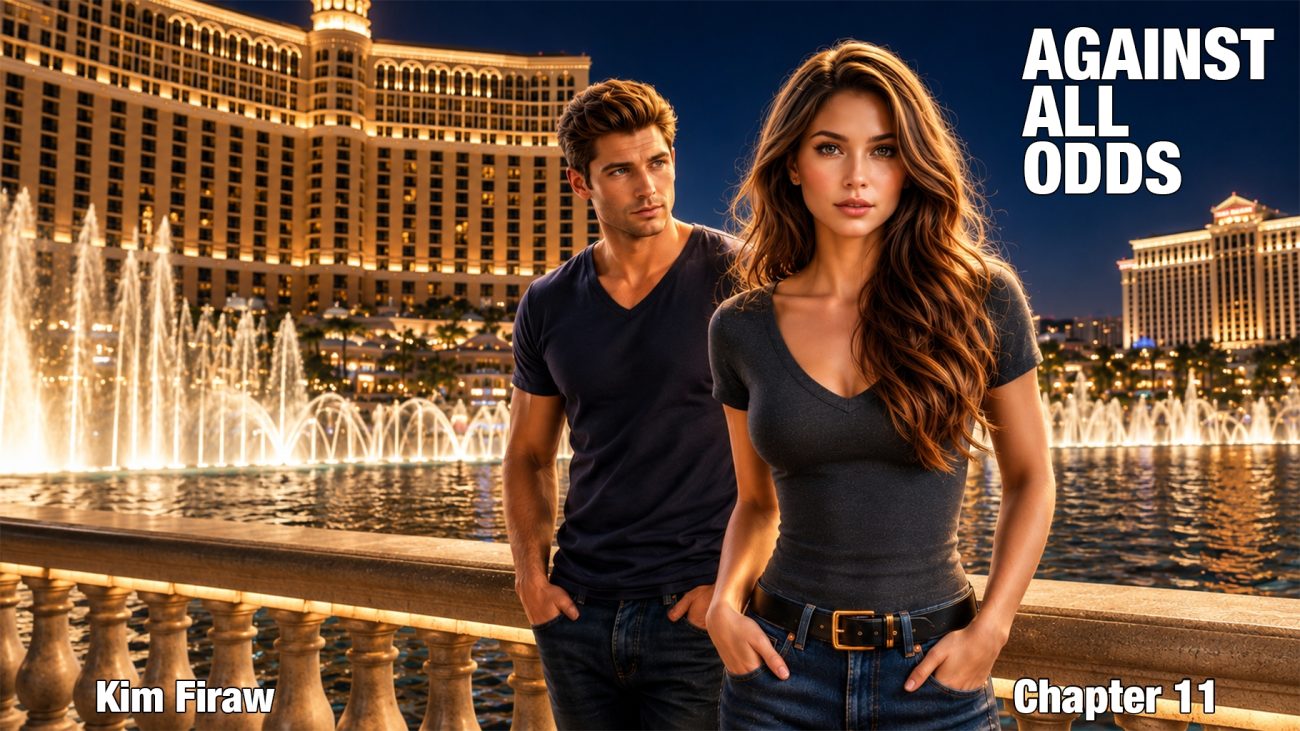
Previously – Chapter 10: Twelve Envelopes
Charles had offered to take the last one by wire. Jake said he’d bring it.
The envelope held one thousand nine hundred dollars, and he did not count it, because he had counted it Tuesday at the bank with a teller named Adaeze watching him do it, and again in his kitchen, and a third time at Midway with his bag between his feet. That was three. He ruled out the fourth at the gate: a man who counts money four times is not checking the money.
The gate code had not been changed in ten years. The ficus in the bathtub-sized pot had died and been replaced by a different ficus, smaller, staked. Behind the pool, where there had been a great dark field of dead grass with nothing happening on it, there were foundations now, poured and cured and laid out in the shape of a street that did not exist yet, with a portable toilet at the end and a roll of orange fencing on its side. He counted the foundations twice and got twenty both times, which settled nothing.
He read that for a while, in November, at eleven in the morning, from a rental he had gotten for twenty-two a day, and told himself somebody out there had made money and it was not his business who, and did not believe himself.
He had been dreading this for a year. Not the money. The money was a standing transfer and a calendar reminder and a decision he had made so many times it had stopped being one. What he had been dreading was the room, and he had run the room a few hundred times, in cars and at four in the morning, and it came out the same every time, because the last one had to be handed across a kitchen thirty feet from a door with a game behind it.
Rosalba let him in. She had a phone tucked under her jaw and a case of water on her hip and she pointed at the island with her chin.
“Ay,” she said, to him, and then, into the phone, “no, the small ones.”
Delia was at the island with tea and the Times folded to the crossword and the green cloth ledger closed by her elbow, in a gray linen shirt, with the reading glasses on a chain and not on her face, where he had never seen them.
“Jacob.”
“Delia.”
“You look,” she said, and considered him. “Fine. You look fine. It’s disappointing. I had a whole thing about your color.”
The coffee arrived without his asking for it and with the milk already in it, in the exact quantity she had been putting in it for ten years, and there were two ways to decline it and both made a thing of it, so there was nothing to do.
He put the envelope on the island.
She opened the ledger. She counted the money the way she counted money, thumb and forefinger, faster than seemed possible for someone doing it accurately, and she was accurate. Then the fountain pen.
1,900 recd 11:06a.
And beneath it, in the same hand: 1,900 to 0.
And then she ruled a line under it, and then a second line under the first, which is what accountants do to a column that is finished, and she did it without any ceremony at all. In the margin she wrote guarantor released and the date.
“There,” she said.
He had come in with three things to say and had ranked them on the plane, and none of them survived the second line, so he drank the coffee.
“Charles will send you something,” Delia said. “It’s six pages and it takes three weeks and it will mean less than this does.” She got off the stool, took the ledger with her, and went out into the hall, where there was a printer on a shelf above the dryer, and he heard the lid go and the light travel and the machine warm up and produce one sheet. She came back with it folded once and handed it over and it was still warm.
He put it in his jacket, and she asked after his mother, and he told her it was the other hip now.
“Of course it is.” Delia sat back down. “They should do them both. My sister did them both and she still complains, but she complains about different things, which is a kind of progress.”
“I’ll tell her you asked.”
“Don’t. She’s never met me and there’s no reason to start.” She filled in a word, looked at it, and did not cross it out, and for Delia that was a decision. “Mabel’s sold, didn’t it.”
“All of it.”
“I’m sorry about the places. I liked the places.” She said it the way she said everything, in the middle of the register, and she meant it exactly as much as she said it and not one degree more. “My nephew still tells people about the anniversary. He has a way of telling it now where the maître d’ knew his name.”
“He probably did.”
“He absolutely did not,” Delia said. “It’s a better story his way.”
Terry came through the kitchen with an ice chest and said “Jake” and Jake said “Terry” and Terry kept going. Out in the hall a man was losing a phone argument about a dealer and continuing it as a formality.
Delia rinsed his cup at the sink.
“Chessa’s got jury duty and Bea’s in Reno,” she said, over the water. “It’s short tonight. There’s a seat at seven-thirty if you’re still in town.”
“No, thank you.”
“All right.” She turned the faucet off and shook her hands twice over the basin, once each. “Seven o’clock traffic on the 95 is a punishment now, in case you’re driving anywhere.”
Rosalba came back through with the empty case flattened under her arm. “You want oranges? She bought eighty-eight oranges.”
“I bought a case,” Delia said. “A case is what they come in.”
“Nobody eats eighty-eight oranges.”
Jake said he was fine on oranges, and Delia said, “Twenty-six across,” to no one, and turned the paper toward the light.
He was out the door at 11:14 and down the driveway at 11:15, and it was November and the concrete gave nothing back, and he had blocked out ninety minutes for it and used twenty, and he stood at the car deciding what to do with the other seventy. Nobody in that house had any idea what had gone on in it. That was correct, and it was the arrangement.
* * *
He sat in the car in the cul-de-sac with the engine running and called Tempe.
“You’re at a Costco,” Jake said.
“I’m in the parking lot of a Costco, which is different, because in the parking lot you can still leave.” Something enormous rolled past on the other end. “What.”
“It’s done. This morning.”
“Okay.”
Jake waited out four seconds of a public address system in Arizona. “That’s it? Okay?”
“What do you want from me, Jake.”
“A little.”
“You paid a bill,” Ray said. “There’s a whole building on Washington where people line up all day to do that. Some of them bring their kids.”
“It was four hundred and twelve thousand dollars.”
“And now it’s not, and you’re sitting in a car.” A cart came past him, the specific rattle of a cart on a curb cut. “Did you eat?”
“I’ll eat at the airport.”
“Don’t eat at the airport. Eat here. The hot dog’s a dollar fifty and it’s been a dollar fifty since the Clinton administration, and it’s the only fixed point left in the American economy.”
“You’re two hundred and eighty miles away.”
“I’m making a general observation.”
Jake put his elbow on the door and looked at the foundations over the roofline.
“She offered me the seat,” he said.
Ray did not say anything for a while, and a long way off a cart went into the corral. “And?”
“I said no.”
“Okay.”
“That’s it? Okay?”
“What’s the alternative,” Ray said. “You want me to be surprised? Twenty-three years and I’ve never once been surprised in a good way. It’d be terrible for my heart.” A door, the interior sound of a car. “How’d it feel.”
“It didn’t feel like anything. It took four seconds. Rosalba tried to give me oranges.”
“Good.”
Jake started to say what it felt like.
“Nope,” said Ray.
* * *
There were seven hours between the last payment and a 6:05 flight, and the plan for all seven was the motel. He spent three of them on Paradise with the television running the same twelve-minute segment about a buffet, and then he got up and put his shoes on and walked to the Bellagio, running the argument the whole way. Four hours, and a building he had never once walked into without a reason, and a man who can only enter a room on business has not gotten anywhere. It held up, which is what he would have said about every argument he ever made.
Junie Park caught him on the diagonal between the poker room and the north escalators, a route he still knew, and she had a tray of empties on her palm and she stopped dead.
“No.“
“Junie.”
“You are a ghost.” She shifted the tray. “Do you know that the last time I saw you, you told me you were finished with this place, and then I saw you like six more times? I stopped believing you. I want that on the record.”
“That’s fair.”
“So are you back?”
“No,” Jake said.
“Okay.” She said it exactly the way she would have said anything, because it was a Thursday and she was carrying twelve glasses and there was no possible reason for her to hear it. “Well, you look good. Did you lose your tan? You lost your tan.”
“I live in Chicago.”
“Why,” Junie said, and waited, as though there might be an answer to it.
He laughed, and she laughed, and behind her a man at a machine hit something small and the machine celebrated for a long time.
“Hey,” Junie said. “The Chicago one. The concierge. With the notes.”
“Lila.”
“Lila. She was so funny. She fixed all my tent cards one night while she was waiting for you. Every one on the station, turned the right way around, and she never said a word about doing it.” Junie was already half-turned, already going, already in the weeds. “Tell her I still think about that.”
“We’re not.” He stopped, because she was eight feet away and it was going to have to be shouted. “Yeah,” he said. “I will.”
* * *
They had renovated the Lily Bar.
He came up the three steps into it and stood there a second doing the thing he did in a room, which he had never managed to stop doing and had stopped minding: two exits, three counting the service door behind the bar, four seconds to it and forty to Flamingo; the well laid out for a right-handed person by someone left-handed; a speed rail with the vermouth in it, which is a sin. The banquettes were gone. The lighting had been raised and warmed. There was a new sign over the back bar, and the sign said the same word it had always said, in lowercase.
Then his sweep of the room stopped, and did not start again.
She was at the far end of the bar with a laptop open and a run-of-show in a plastic sleeve beside it and a glass of white wine she had not touched, because there was condensation running off it onto a napkin that had gone transparent.
He had twenty years of practice at deciding what to do in the first second in a room. He used all of it and came up with nothing.
She looked up. “No,” Lila said.
“Hi.”
“No. Sorry. Hi.” She closed the laptop halfway and then opened it again, and he had never once seen her hands do a thing like that. “I’m sorry. I said no out loud.”
“You did.”
“This is a hundred and twenty-two acres,” she said. “I want the record to show that.”
“It’s a hundred and twenty-two acres and we live eleven miles apart.”
“Twelve,” she said.
He had the answer in his mouth inside a half second, priced it, saw where it went in three moves, and left it exactly where she had put it, and leaving it took everything he had.
“I looked it up once. It was a bad night.” She said it flatly, and then took the wine and drank some of it and put it back down on the transparent napkin, and neither of them did anything with that at all.
One stool over was a proposal, three was a statement, two said nothing, and he ran all of it standing up in about a second and hated that he had. He sat down two stools away and ordered a soda water, and the bartender brought it in a glass with a wedge of lime crushed into the bottom of it by a person in a hurry.
Two stools is thirty-one inches. He knew it the way he knew the height of a bar die, without being asked, and somewhere in the first half hour he understood he had measured this one and was going to keep measuring it.
Somewhere in there the 6:05 left without him. He felt it go, the way you feel a door shut in another room of a house, and behind it there was a 9:40 and a red-eye at 11:55 and a 7:15 Friday, all three in his head without looking, and he did not reach for his phone and he did not mention it.
“You’re producing something,” he said, and she said that she was, and he asked how it was going.
“It’s a beverage launch,” Lila said. “It’s a functional beverage. I have to say ‘functional beverage’ out loud six times a day to grown adults with jobs.” She put two fingers on the plastic sleeve and moved it half an inch. “They want the product to come up through the floor.”
“Up through the floor.”
“Up through the floor of a ballroom on the second level. There is a Pilates studio underneath that ballroom. There are people doing Pilates under the hole they want me to cut.”
“So you told them no.”
“So I told them yes and I’m doing it with a lift and a false deck and a scrim, and it will look like it came up through the floor, and it will cost them ninety-one thousand dollars, and the whole thing takes four seconds.” She drank some more of the wine. “They saw it in a Super Bowl ad.”
“They always saw it in something.”
“They always saw it in something.”
There was a tent card on the bar between them, facing the wall. He caught her clock it and leave it, and said nothing about that either.
“You have people?” Jake said.
“I have three. One of them’s mine, two are freelance.” A pause the length of a swallow. “I have a van.”
He had four responses and ran all four to the end, and every one arrived back at him, so he used none.
“It’s a 2019,” she said. “It has a hundred and twelve thousand miles on it and it smells like a florist died in it.”
“Congratulations.”
“Thank you.” She turned the stem of the glass. “Why are you here?”
“I paid Delia this morning. That was the last one.”
Lila went very still, in the small way she did it, mostly in the hands.
“Did she give you anything?”
Of course that was the question. He got the photocopy out of his jacket and unfolded it once and put it on the bar, because she was a woman who had spent six years getting people to produce paper, and she read it the way she read a banquet event order, top to bottom, and then again.
Seventy-seven thousand two hundred and forty dollars of what that page was the end of had come out of a savings account in Chicago on a Tuesday afternoon in a single wire, and neither of them said so. There were two more words on the page, in the margin, and she read them and did not touch them.
She folded it back along the fold he’d made and slid it over.
“She double-ruled it,” Lila said, and he said that she had, and Lila looked at the page a while longer. “That’s correct, actually. That’s what you do.”
“I know.”
He put the receipt back in his jacket. Then he took it out again and laid it flat on the bar where she could keep it in front of her, because some of what was on it was hers.
“There’s the other one,” he said. “Six hundred a month, a hundred and twenty-one months. I write it down on the first and the number under it doesn’t move, because the account it was going to is closed. I’m not asking you to open it. I’m telling you it’s on a page.”
Lila looked at the receipt for longer than she needed to.
“That one doesn’t get a line under it,” she said.
“No. Not for a long time.”
* * *
The staffing was the safe country and they both went to it at the same time.
“Three,” Lila said. “Four if you count the guy with the iPad, but he’s expediting the food, so he’s on a different cost center.”
He had counted them on the way in and gotten the same number, and did not say so, and she knew it.
“They cut it in half and put in a chef’s counter,” she said, tipping her head at the far end, “and now it’s a restaurant with a bar problem.”
“The music’s the same volume it was two hours ago.”
“That’s not possible,” she said, and then listened to the room for a second, and it was the same volume. “Then somebody put a lock on it,” she said, with genuine feeling. “I would like to shake his hand.”
Below them the floor did what it did. Jake watched a dealer change without watching her, and did not put a number on anything, and drank his soda water, and found that this was survivable.
“Okay,” Lila said. “Two-top. Blue banquette. Woman with the folder.”
He looked. Fifty, folder, phone face-down on the table. Across from her a man in his sixties in a golf shirt with a very good watch on the wrong wrist.
“She’s going to get it,” Lila said.
“Get what?”
“Whatever it is. Money. She’s asking him for money.”
Jake looked at it some more. Two years ago the shape of the thing would have arrived in him whole, in under two seconds, with a number attached, and he’d have said the number out loud before he’d finished deciding to.
Nothing arrived.
“I don’t know,” he said.
“Guess.”
“I think they already did it,” he said. “I think that’s the dinner after.”
“It’s not the dinner after.”
“Then I’ve got it backwards.”
The man in the golf shirt said something. The woman turned the folder around and slid it across the table, and he took a pen out of his own pocket, which is the whole story, and wrote on the top page, and slid it back with two fingers, and she looked at what he’d written for slightly too long before she smiled.
“Yeah,” Jake said. “That’s not the dinner after.”
He drank his soda water. And then he caught it: she had not moved, she was still turned toward him with her chin down, waiting, holding a space open at the end of the exchange for a thing that was supposed to go there. A number. A recount. The half of it he’d had right.
He didn’t have one, and after a moment she looked back at the room.
“Huh,” Lila said.
“How’d you know?”
“He ordered second.” She was still looking at the banquette. “She ordered and then he ordered the same thing. Men don’t do that when they’ve already decided no. If he’d decided no he’d have ordered something else and been quick about it, so that the meal would be short.”
“That’s good.”
“It’s not good, it’s just true.” She finished the wine. “I had a whole thing I was going to say, by the way. If this ever happened. I worked on it.”
“What was it?”
“It was very good,” Lila said. “It’s gone.”
* * *
She said she had to go at 12:40 and paid for the wine and closed the laptop and put the run-of-show in her bag, and he stood up when she stood up, and they went down the three steps and out across the floor together because it was the only way out.
Halfway across, a bachelor party came the other way four abreast and did not yield, and his right hand came up off his side to go to the small of her back and steer her out of it, the whole motion, elbow and all, and he caught it at about two inches and put it in his pocket. She went around them herself. She had always been able to.
At the doors he was going left toward Flamingo and she was going left toward Flamingo, and they kept walking.
It was sixty-one degrees. She had her arms crossed over the front of her jacket in the way of a person who is a little cold and has decided not to be a person who is cold.
He had his own jacket off one shoulder before he knew he had started it. He got it as far as the elbow. Then he stood on Las Vegas Boulevard at ten past one in the morning and put it back on, one arm and then the other, like a man who had misjudged the weather, because every route through the offer ended with her having to tell him no, and she would do it kindly, and the kindness was the part he could not have carried.
He walked the next two blocks with his hands shoved in his pockets, and when he took them out at the light his knuckles had gone stiff.
The men with the flyer cards were out along the block snapping them against their palms, that dry insect rhythm, and one of them worked them both without looking up.
“How’s Ray?” she said.
“Tempe.”
She made a face at that, and he watched her decide not to say the thing about Arizona she had clearly been carrying around for some time.
“He has a patio. He sends me photographs of the patio. There’s nothing on it.” Jake stepped around a puddle that had no business being on a sidewalk in November. “He calls it a lanai. I’ve told him it’s a slab.”
“Is he all right?”
“He’s fine. He’s insulted by the sun.” He put his hands in his pockets. “It’s worse than if something had happened to him, honestly. Something happening would at least be interesting.”
Lila made a small sound that was not quite a laugh.
Outside the steakhouse, closed an hour before, a doorman was folding a velvet rope over his arm, and he looked up.
“Evening, Mr. Dalton.”
“Evening, Paul.” Jake slowed. “How’s your mother?”
“She passed in February,” Paul said, and kept folding, because he had said it a hundred times by now and had a system for it. “Eighty-eight. She was ready. I wasn’t.”
Jake stopped walking. “I’m sorry, Paul.”
“Well.” Paul put the rope over the stanchion and squared the stanchion with his foot. “She asked about you once, you know. Couple years back. She’d say, that’s the one who sends the cards.”
“I stopped sending the cards.”
“Everybody stops sending the cards,” Paul said. “Goodnight, Mr. Dalton. Ma’am.”
They walked another half block before either of them said anything, and what Lila said was, “Okay,” quietly, to nothing in particular, and Jake said “Yeah,” and that was the whole conversation about it.
* * *
The escalator up to the pedestrian bridge was roped off with a man down inside the open plate, so they took the stairs.
Halfway up, a stag party came down and took the whole width of it, and she stepped in against the rail to let them by and he stepped in too, and for four seconds they stood there closer than they had been in a year. He had three things and none of them fit inside four seconds. Then the last of them went past and she went up.
At the top a woman in a wedding dress sat on the concrete with her heels beside her, saying into a phone, “No, I know. No, I know,” and neither of them said anything about her.
“How’s Sophie?” Jake said.
“Sophie’s Sophie. She and Theo bought a house in Portage Park with a tree in the parkway that the city has been coming to look at for two years.”
“Coming to look at it.”
“Three separate men have come and looked at it and written something down and left. She’s godmother to my van. She named it, and I’m not telling you what she named it.”
“That bad.”
“The other way. It’s so sincere I can’t say it out loud on the Strip.”
He asked her what the first year had actually cost (not the number, the shape of it) and she told him: the wedding on Kinzie she took because she needed the money, the client who paid at a hundred and six days, the fire marshal in Skokie who turned out to be right. He asked the second question, and then the third one, and she stopped in the middle of an answer about a loading dock.
“You’re doing the thing,” she said.
“I know.”
“You’re doing the thing where you ask me questions.”
“I know,” Jake said, and then, because it was there and it was true and it was no use to him at all, “I eat dinner at four-thirty at a steel table in a basement with three cooks who don’t like each other. Five days a week, two years. Last spring one of them asked me what I did before. I said I’d been in restaurants and let that be the whole answer.” He shrugged. “I’ve done that about a dozen times now.”
Lila looked at him for about a step and a half. “What’s it called,” she said.
“Tarrant’s. It’s on Ohio. It’s fine. The creamed spinach is genuinely good and nobody knows, because who’s going to find out.”
* * *
They came around to the front a little before two and the fountains were done for the night. The lake sat flat and black, eight and a half acres of it, with the whole building doubled upside down and not moving.
Out in the middle a man in a small flat boat with a light strapped to his hat went slowly along, taking things off the surface with a net on a pole.
They stopped at the rail. She put her forearms on it. He put his hands on it.
“That’s not the same guy,” Jake said.
“How can you tell?”
“I can’t.”
“Then why say it?”
“Because it’s been two years,” he said. “Nobody’s the same guy for two years.”
The boat went out past a submerged nozzle. The man reached over the side and picked something out of the water and dropped it in the bottom of the hull, and did not look up at them, and there was no reason he ever would.
Jake took his hands off the rail and put them back. He had four ways in, and three started by explaining why he was telling her, which is a way of asking for something.
“I have to tell you something,” he said. “It isn’t for anything.”
She waited.
“The morning I called you. In Vegas. The morning I told you the number.” He kept his eyes on the water because it was easier and then made himself stop doing that and looked at the side of her face instead. “Before I called you, I was on the fourth level of a parking structure on West Charleston and I opened my laptop and I logged into your bank.”
Lila did not move.
“I had your password,” he said. “You gave it to me in August, on the phone, from a service corridor, because there was a two-hundred-and-six-dollar charge from a company called Sundries and you had a man from Osaka in the lobby. Norwood, two thousand sixteen, exclamation point. The site made you put the exclamation point.”
“I remember.”
“I opened the savings account. Seventy-seven thousand two hundred and forty dollars.” He said the number the way Delia wrote numbers, flat, correct, without decorating it. “I scrolled it. Four hundred dollars every other Friday, going back six years, and then six hundred about three years ago, and then it stayed six hundred. There was one withdrawal, two thousand, in November, and then four deposits of eight hundred until it was back where it had been, and then it went to six again.”
The water did not do anything.
“I loaded it as far as the site would go,” Jake said, “and then I sat there. Long enough for the fan to come on. And then I closed it.”
Nothing.
“That’s the whole thing,” he said. “I didn’t take it. I didn’t try to. There was nothing in the world stopping me and I want to be accurate about that, because the version where something stopped me isn’t true.”
Lila straightened up off the rail. She walked about eight feet down along it and stood there with her back to him, and he let her, because there was nothing to do that was not a move, and did not follow and did not say anything into it.
Then she came back.
“You looked at the deposits,” she said.
“Yeah.”
“All of them.”
“As far as it would load.”
She nodded slowly, twice, the way she nodded when a vendor told her a truck was two hours out.
“Why are you telling me this now?”
“Because you don’t know it,” Jake said. “That’s the only reason there is.”
She turned around and put her back against the rail and looked at the hotel instead of the water.
“I don’t know what to do with that,” she said.
“You don’t have to do anything with it.”
She started to argue and stopped, and pressed her thumb into the heel of her other hand, hard. “I’m going to have to think about that for a long time.”
“Yeah.”
“Like a year.”
“Yeah.”
“I’m not going to say anything nice about it,” Lila said. “I want you to understand that I’m not going to.”
“I know.”
“Because I can feel myself wanting to and I’m not going to.”
“That’s right,” Jake said.
She turned back around and put her forearms on the rail, and she did not measure the distance before she did it, and the outside edge of her hand came down against the outside edge of his.
Neither of them moved.
An inch of skin. The blade of a hand, the part you sweep crumbs off a table with. He had handed over the last of four hundred and twelve thousand dollars that morning and said no to a seat at seven-thirty, and none of it had reached him anywhere. This reached him. He stood with his heart going like a man on a ladder and did not turn his head and did not look down, because looking down would have named it, and the second it had a name she would have to do something about it.
Out on the water the man in the boat came about, slowly, and started back down the far side, and the light on his hat swung across the black and lit up a foot of it and moved on.
Then she pushed off the rail with both hands at once, and put her thumb into the heel of her other hand, caught him watching her do it, and stopped.
* * *
Her phone went off in her bag and she looked at it and put it back without answering.
“Load-in’s at seven,” she said. “The lift comes at six-thirty and it will not come at six-thirty. I’m going to be standing in a service corridor at six-fifty on the phone with a man named Duane.” She got her bag up onto her shoulder. “Okay.”
“Can I ask you for one thing,” Jake said.
Lila’s face did something complicated and closed most of the way.
“Coffee,” he said. “Saturday. That’s the whole ask. There’s a place on Twain behind the tire store that’s a coffee shop the way a bus station is a coffee shop. Nine o’clock.”
And then he stopped talking, because that was the end of the sentence.
There was a beat on the end of it with room in it, and he did not fill it. He tracked her eyes coming up into it, and waiting.
She didn’t say anything about it.
“Nine,” she said, and did not hang a condition on the end of it. He marked that, and let it alone.
Then she got her phone out and put it in the calendar, standing there with her bag on her shoulder, nine o’clock Saturday, and turned the screen off and looked at him a second longer than the transaction required.
“Nine,” she said again.
She went in through the doors, past the flowers, across the marble, and did not look back, and he did not stand there and watch her the whole way.
He turned around and put his elbows on the rail again.
A cab came up the ramp to the stand and stopped, and the driver looked over at him with his eyebrows up. Jake shook his head. The cab waited the full interval anyway, the way they do, and then pulled off around the drive.
He stood there and put himself on a Saturday afternoon flight instead, two minutes and a hundred and sixty dollars, and there was a version of the next thirty-two hours where he spent none of them in this town, and he had it costed before he finished paying, and bought the seat anyway and put the phone back in his pocket.
It was 3:12 in the morning and the motel was three miles and he had the receipt folded in his jacket and until Saturday, so he started walking.

2 thoughts on “Against All Odds – Chapter 11: No, Thank You”