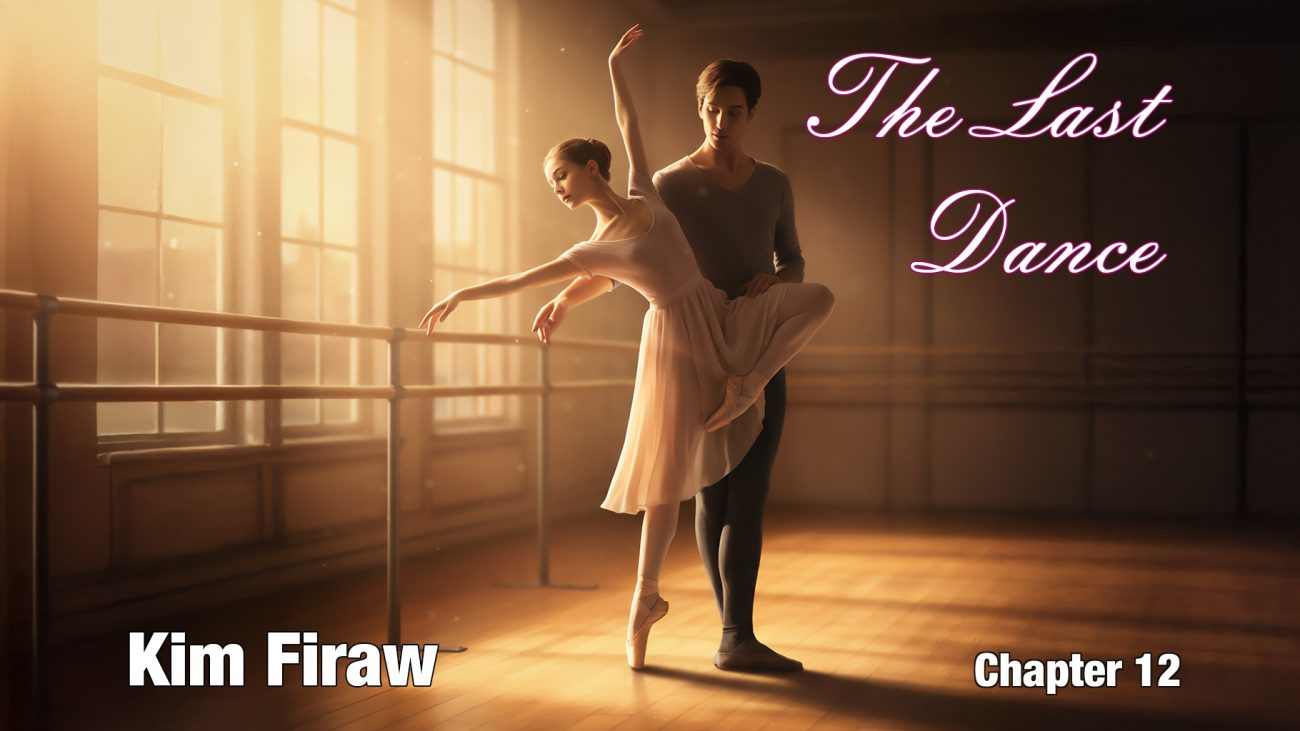
Previously – Chapter 11: Two Children
The key to Lockwood Dance Academy stuck in the lock the way it always had, and Mia had learned to lift the door by its handle while she turned it. She got the deadbolt on the third try. Five-forty in the morning, black outside, and her breath showed in the lobby until she found the thermostat.
She left the overheads off. There was enough light coming through the front windows from the streetlamp to see the floor by, and the floor was all she wanted.
Her cane made a soft double knock on the boards: tap, and then the shuffle of her right foot catching up. She had stopped hearing it around week three. This afternoon she’d hear it. This afternoon there would be eighty people in folding chairs, and every one of them would hear it too, and there was nothing to be done about that.
She set the cane against the barre and stood in the middle of the floor with her arms loose.
The closing number still didn’t work.
They had run it four times on Thursday and it had failed four times in the same place. The little ones finished their section downstage and had to clear so the teens could come on, and there were eight bars of nothing while sixteen six-year-olds walked into the wings in a clump, and eight bars of nothing in a five-minute piece was a hole you could drive a car through. Adam wanted to cut the music. Mia had said no, and had not said why, because saying why would have meant saying the problem isn’t the music, and they had not been talking well enough for that.
She marked it now. Not danced. Marked. Hands doing what feet would do, the whole phrase scaled down to something she could hold at chest height, the way you learn to in a rehearsal room when there are forty people and space for six. Her right hand made the children’s exit. Her left brought the teens on from upstage left. Sixteen counts. She said the counts under her breath, and on five-six-seven-eight her hands arrived at the same place at the same time and collided.
She did it again slower and watched her own hands.
The children were walking off because that was what you did. That was the whole reason. Nobody had asked whether they should.
Mia stopped. She stood in the dark with her hands still up and thought: don’t clear them.
She marked it a third time. The teens came on through the children instead of after them, around them, between them, the way water goes around stones. And the children didn’t leave. They sat. Right there, downstage, cross-legged on the floor where they’d finished, and they stayed for the rest of the piece, and at the end they were still there, sixteen small bodies at the front of a stage full of dancers twice their size.
No hole. No eight bars of nothing. And an image at the curtain that she had not gone looking for.
Her hands came down. Her hip had begun the low grinding ache that meant she’d been standing on it without noticing, and that was its own kind of good news.
She found a pen behind the reception desk and wrote on the back of a class-registration form: closing, don’t clear the babies. Teens enter THROUGH. Babies sit and stay. Then, underneath, because Adam would ask: no music change.
The front door opened behind her with the particular scrape it made when someone pulled instead of lifting.
“It’s five-fifty,” Lucy said. “In the morning. On a Saturday.”
“You’re here.”
“I’m here because I set an alarm like a person with a job.” Lucy came in sideways, a cardboard tray in one hand and her laptop bag sliding off the opposite shoulder, and set both on the desk. “You’re here because you didn’t sleep. Which one.”
“Coffee’s for me?”
“One of them is.” Lucy handed it over. She looked at the dark studio, and the barre, and the cane leaning against it eight feet from where Mia was standing. She didn’t say anything about the cane.
Mia drank. It was too hot and she drank it anyway.
“Is he coming in early?” Lucy asked.
“He said six-thirty.”
“So he’ll be here at six.” Lucy pulled the laptop out and opened it, and the screen lit her from below, blue and unkind. “Are we doing this all day? The two of you being extremely polite?”
“We’re not being polite.”
“Mia.”
“We’re being professional.”
“That’s worse and you know it’s worse.” Lucy typed something. “For what it’s worth, I’m not asking what you said to him.”
“Good.”
“I’m just noting that whatever it was, it landed, and he’s been carrying it around for a week like a man with a stone in his shoe.” She scrolled. “Also we’ve sold sixty-one tickets. Eleven more than last year. And forty-one of them are people who are contractually obliged to come because their child is in it, so let’s all stay calm.”
“What’s the other twenty?”
“Fourteen grandparents, four of Mrs. Fletcher’s church, one man who I think misread the poster and believes he’s coming to a craft fair, and Diane from the diner, who told me she’s coming because she heard the professional one was involved.” Lucy looked up over the laptop. “That’s you. You’re the professional one. Try to look professional.”
Mia put the registration form down on the desk where Adam would find it. She squared it against the edge of the blotter. It was not a thing that needed doing.
“He’ll be fine,” she said.
“Sure,” Lucy said, and went back to her spreadsheet.
* * *
He was there at six-fifteen.
Mia heard the truck before she saw him: the door, and then the tailgate, and then six minutes of him carrying folding chairs in from the bed of it, four at a time, without asking anyone for help. She counted the trips. Six.
By seven Mrs. Fletcher had arrived with a card table and a hand-lettered sign that said REFRESHMENTS, PLEASE HELP YOURSELF, and a second sign, unexplained, that said NO NUTS IN THE BROWNIES (THERE ARE NUTS IN THE COOKIES).
“That’s not a very reassuring sign,” Mia said.
“It’s an honest sign.” Mrs. Fletcher taped it down. “Beverly Ann makes the cookies and she will not be told.”
By eight there were volunteers, and the good hum of a room being turned into a different room: chairs scraping into rows, a stepladder, somebody’s father up it with a staple gun and a string of fairy lights, three teenagers arguing about where the phone should go for the video.
Two of the eight-year-olds had arrived four hours early in full costume and were sitting on the floor of the lobby doing nothing whatsoever with tremendous seriousness.
At nine the lights went out.
Not all of them. That was the thing that made it take four minutes to understand. The house lights over the seating stayed on and the four cans over the floor died, all four at once, along with the amp. Mia felt the sound go before she saw the light go, that particular vacuum where a room’s electrical hum stops.
The man on the stepladder said a word he immediately apologized for.
“Sorry. Sorry. Kids present.”
“They’ve heard it,” said one of the eight-year-olds, from the floor, without looking up.
Adam came out of the office fast.
“I plugged the second bar into the strip by the mirror,” Kyle said, already down the ladder. “That’s all I did.”
“Then it’s the panel.” Adam put both hands on the back of his neck and looked at the ceiling. “It’s forty years old and I have been not thinking about it since June.”
Mia crossed to him. The floor was full of people not yet aware there was a problem, and she kept her voice at the level you use to say something ordinary.
“How long for an electrician on a Saturday?”
“On a Saturday in Pine Falls.” He laughed, not really. “Ninety minutes if we’re lucky. Two hundred dollars before he touches anything.”
“Then we call one.”
“Mia.” He stopped. Started again, lower. “The doors are at eleven. If he can’t fix it we’ve got eighty people sitting in the dark watching kids they can’t see.”
“So we don’t put them in the dark.”
“There’s no.”
“Adam.” She waited until he looked at her. “West windows.”
He looked at the west windows.
It took him about three seconds, and she watched him get there, and something in her chest did what it had been doing since September and she ignored it.
“The blinds,” he said.
“Take them down. All of them, not up. Down, off the brackets, so there’s no slat shadow on the floor. That’s five windows of full south-west light from eleven to about one.” She had the schedule in her head already, had been building it since the moment the amp died. “You reorder. Everything that was going in the second half goes first, because that’s the hour with the light. The two teen pieces that need the dark go last, and if the electrician’s here by then we do them properly.”
“And if he isn’t, we do them anyway.”
“We do them anyway. The advanced kids can dance in a parking lot. They’d dance in a parking lot.”
Adam breathed out. He looked at the room, at Kyle already halfway to the breaker panel, at the fathers with the staple gun, at his own hands.
“The sound,” he said.
“Is your phone charged?”
“Yes.”
“Then we have sound. It’ll be terrible. Nobody in that room has ever been to a performance where the sound was good, so nobody will know.” She shifted her weight off the right leg. “Get me the running order and a pen. I’ll redo it while you do the blinds.”
He didn’t move for a second.
“What,” she said.
“Nothing.” He picked up the stepladder. “I was going to cancel.”
“I know.”
“You knew before I did.”
“Adam, go and take down the blinds.”
He went. She watched him go, and then she sat down on the edge of the risers with the clipboard, because her hip had opinions, and she reordered a two-hour show in seven minutes and got it right the first time.
There was a difficulty at ten past ten involving a six-year-old called Rosalie who had decided, apparently in the car, that she was not going to be in it. She had gone under the reception desk. Her mother had tried reason, and then bribery, and had now gone out to the parking lot to have a small private breakdown.
Mia lowered herself into Mrs. Fletcher’s chair, more or less at desk height, and did not look under the desk.
“Rosalie.”
Silence.
“I’m not going to ask you to come out.”
More silence, of a slightly different quality.
“I’m going to tell you something instead, and then I’m going to go away.” Mia looked at the front door. “When I was twenty-two I was in a company in Detroit and I did a show where I had eleven counts on my own at the front, and about four hours before it I sat in a closet where they kept the mops, and I didn’t come out until somebody found me.”
A long pause.
“Did you do the show?”
“I did the show.”
“Was it good?”
“It was fine,” Mia said. “It was completely fine. That’s the annoying part. I spent an hour in a closet and then I went out and it was fine and nobody remembers it but me.”
Rosalie came out from under the desk at about half past ten, of her own accord, and was in it, and was fine.
They didn’t speak again until quarter to eleven, and then it was: risers or no risers for the mother-daughter, and she said no risers, and he said right, and that was the whole exchange, and it was the easiest either of them had been with the other since the night in his lobby when she’d told him the truth about why he kept rescuing people.
We’re better at this than we are at anything else, she thought, and put the thought down where she wouldn’t trip on it.
* * *
The doors opened at eleven into a room full of afternoon.
It looked, Mia had to admit, better than the lights would have. Five bare windows and no blinds, and the whole west wall pouring in across the floor in a long slab, gold on the boards, the mirrors throwing it back so the room was lit from two directions and neither of them was overhead. It looked like a photograph of a dance studio rather than a dance studio. Nobody sitting down in those folding chairs would ever know it hadn’t been the plan.
The beginners went first, in pastel, and were the exact disaster you would want. One of them waved. Two of them turned the wrong way at the same time, saw each other, and corrected in unison with such gravity that the room laughed and then applauded the correction.
Mia stood at the side with her back against the barre, the cane hooked over it beside her, watching the counts land.
The mother-daughter duo went third and was the single most alarming thing on the program, because the mother was a nurse practitioner with no training whatsoever who had signed up in September on a dare, and because the daughter was eleven and had reached the age of being mortified by everything. They had rehearsed it, Mia knew, in a kitchen.
They were terrible, and they knew they were terrible, and the mother did a small unscripted shrug at the audience halfway through that got the biggest laugh of the afternoon, and at the end the eleven-year-old was crying and hugging her, and Mia thought: that. That is what he’s selling and Crestwood cannot make it.
She spotted Danielle King during the fifth piece.
Back row, right-hand end, wool coat still on. She had come in through the fire door at the side, which meant she had walked around the building rather than through the front where Mrs. Fletcher would have said hello to her.
Lucy appeared at Mia’s elbow.
“Is that who I think it is.”
“Yes.”
“Do we do something?”
“We do the show,” Mia said.
“I could offer her a cookie. There are nuts in the cookies.”
“Lucy.”
“I’m going to offer her a cookie.”
She did, in fact, offer her a cookie. Danielle declined it pleasantly and Lucy came back looking dissatisfied.
Danielle watched the sixth piece with her hands in her pockets. She watched the seventh the same way. She didn’t lean over to whisper to anybody, because there was nobody with her, and she didn’t take a photograph. She sat very still and she watched the way people watch when they are working.
At half past twelve Adam announced the advanced teens.
They came on in black, six of them, and Tori was second from the left. Mia had built the piece in October and rebuilt it twice in November, and it was four minutes long and it was the only thing on the program that could have been performed on a real stage in a real city without apology.
The light was going by then. Twenty past the hour, the slab across the floor gone thin and orange, the mirrors dimming. It made the piece look better than it was. It made the six of them look like they were dancing at the end of something.
Tori had the phrase at 2:40. It was the hardest thing Mia had asked anybody in Pine Falls to do: a long fall out of a turn, caught late, so late that it read as an accident for half a second before the catch. They had worked on it for five weeks. Tori had gone down hard on it in front of everyone twice in October and got up both times without looking at anybody.
She caught it.
Not perfectly. She was a beat early on the recovery, and her back foot skidded a half inch. Mia saw it. Three hundred people in the world would have seen it and two of them were in this room.
Mia looked at the back row.
Danielle King had taken her phone out of her coat pocket. She wasn’t filming; the screen was dark side up, angled down against her thigh. She was typing with one thumb. She typed for perhaps four seconds. Then she put the phone away and went back to watching with her hands in her pockets, and her face had not changed at all.
Charming, Mia thought. She’s writing ‘charming’ to somebody.
She was so certain of it that she turned away and missed the end of her own piece.
* * *
The electrician arrived at ten to one and had the panel open by one and the lights on at twenty past, and the room made a noise about it that was disproportionate and lovely: a whole cheer, eighty people cheering a man in a fleece for flipping a breaker.
Adam put the microphone on. “Ladies and gentlemen, Lockwood Dance Academy would like to formally thank Pine Falls Electrical, who is not, I promise you, being paid enough for this.”
Laughter. The electrician raised a hand without turning around and kept packing his bag.
“We’ve got one more,” Adam said. “Everybody’s in it. If you have a child in this building, they’re in it. So.”
He looked over at Mia, and she nodded once, and he said: “This is called Everybody Comes Home.”
They had changed the ending at ten past nine that morning with a pen on the back of a registration form and forty minutes of frantic explanation to sixteen six-year-olds, and it had no business working.
It worked.
The children finished their section and did not leave. The teens came on around them and through them, stepping wide, one of the older boys turning his whole body sideways to get past a girl who came up to his elbow and who did not move an inch because nobody had told her to. And the children sat down where they were, cross-legged, at the front, sixteen of them in a ragged line facing out at their own parents, and stayed there for two and a half minutes while the piece happened over their heads.
Rosalie, who four hours earlier had been under a desk, sat in the middle of the front row of them with her chin up like a small empress.
At the end the teens were behind them in a wide shallow arc with their arms up, and the children were still sitting at the front, and one of them, the one who had waved at the beginning, waved again.
The room came apart.
Mia had been in the wings at the Auditorium Theatre in Chicago when eighteen hundred people stood up. She knew exactly what she was hearing and exactly how much smaller it was. She held the barre with one hand and let it happen to her anyway.
Lucy was crying without any embarrassment at all. Mrs. Fletcher had both hands pressed to her mouth. Adam was standing at the far side of the floor with the microphone hanging forgotten at his hip, and he was not looking at the dancers.
* * *
It took forty minutes for the room to empty, because it always did, because everybody had to tell everybody.
Mia got as far as a chair in the second row and stopped there. Three separate mothers asked her about the spring term. A man she didn’t know told her that his daughter had come home in September saying she wanted to quit, and had not said it since. A ten-year-old brought her a paper cup of lemonade and left before she could say thank you.
Rosalie’s mother came over and could not get the sentence out and Mia said, “She was excellent,” and Rosalie’s mother said, “She was under a desk,” and had to go away again.
Sylvia and Don Wilcox came over during the thinning-out, and Sylvia was carrying flowers.
Two bunches, wrapped in the paper from the store on Main, and Mia saw what they were before Sylvia had crossed half the floor. Roses. Cream ones, the small kind.
“For you,” Sylvia said. “And there’s Adam’s.”
Mia took them. There was a moment where she should have said something and it went past.
“They were Heather’s favorite,” she said instead.
“Yes.” Sylvia’s chin moved. “Don thinks it’s morbid.”
“I didn’t say morbid,” Don said. “I said she’d have found it funny. Getting her own flowers.”
“She would have,” Sylvia said, and looked at the empty floor, and then at Mia, and touched her once on the arm. “That last one. With the little ones staying.”
“That was this morning. That was a fix for a hole in the middle.”
“Was it,” Sylvia said.
She went off to find Adam. Don stayed where he was for a moment with his hands behind his back, rocking slightly on his heels, a man in a room that had nothing in it for him.
“Good turnout,” he said.
“It was.”
“Right,” he said, and followed his wife.
Mia was still holding the roses when Danielle King came down the side of the room.
Up close she was smaller than she looked from a distance, and the coat was very good, and she stopped at a conversational distance and did not offer her hand.
“That was better than I expected,” she said.
“Thank you.”
“The last one was clever. The children staying put. You don’t see that. Most people clear the stage because clearing the stage is what you do.” Danielle glanced at the floor where it had happened. “Yours?”
“It’s a company piece.”
“That’s not what I asked.”
Mia said nothing.
“Well.” Danielle let it go with an air of having filed it. “The woman on the door offered me a cookie in a way I found quite threatening.”
“There are nuts in the cookies.”
“I gathered.” Danielle almost smiled. “We’ve got our opening night tomorrow. Six o’clock, there’s a reception, Derek Raines is doing the second half. You should both come.”
Adam had arrived at Mia’s shoulder without her hearing him.
“Thanks,” he said. “We’re busy.”
“You don’t know what time it starts.”
“We’re busy at all the times.”
Danielle smiled at that, and it was a real smile, and somehow worse than the other kind.
“The invitation stands,” she said. She took a card out of her coat pocket, heavy stock, silver on white, and held it out, and when Adam didn’t take it she set it down on the arm of the folding chair beside him. “It’s a big room, Mr. Lockwood. There’s space in it for more than one studio.”
She left through the front, and said something pleasant to Mrs. Fletcher on the way past, and Mrs. Fletcher said something pleasant back.
* * *
By half past three there was nobody left but the two of them.
The chairs were stacked. The card table was folded against the wall with the sign still taped to it. Somebody had swept, badly, and there was a drift of glitter along the base of the mirror that would be there in April.
Adam came out of the office with the cash box under one arm and stopped when he saw her still sitting in the second row.
“You should be off that hip.”
“I’m off it. I’m sitting.”
“You’ve been sitting for four hours in a folding chair, and that is not the same as.” He stopped. Put the cash box down on the desk. “Sorry.”
“Don’t.”
“No, I’m.” He pushed both hands back through his hair. “I’ve got about nine things I’ve been trying to say to you for a week and they all come out as you should be off that hip.”
Mia set the roses down on the chair beside her.
“Say one of them.”
“You were right,” he said.
She waited.
“A week ago. In the lobby.” His hands went into his pockets and came out again. “About why I do it. Connor, and the work-study I invented on the spot that we cannot afford, and Tori’s fees, and all of it. You said I keep pulling people out of the water because I couldn’t pull her out. And I said some things back that weren’t about that at all, and then I went home.”
“Adam.”
“I’ve had a week to find the flaw in it,” he said. “There isn’t one. That’s the problem. There’s no flaw in it. You were just right, out loud, in my own lobby, on a Friday evening.”
The room was very quiet. Outside, somebody’s car started.
“I shouldn’t have said it like that,” Mia said.
“You should have said it exactly like that. Nobody else is going to.” He looked at the floor for a while. “Heather would have. That’s the thing I couldn’t get past. It took me until about Thursday to work out why it made me so angry.”
Mia put her hand on the back of the chair in front of her and got up. It took a moment, and she let it take the moment instead of hurrying it, and he watched her do it and did not come over to help, which she would remember later as the kindest thing he did that day.
She crossed to him.
“I’m not her,” she said.
“I know.”
“No. Adam. Listen to the sentence.” She was close enough now to see that he hadn’t slept either. “I’m not her, and I’m not going to spend whatever this is being careful about it. If I think you’re doing something stupid I’m going to say so. Every time.”
“Okay.”
“That’s the deal.”
“I said okay.” His voice had gone rough. “Mia, I’m agreeing with you. I’ve been standing on the other side of this building for a week trying to work out how to agree with you.”
She started to say something else and he kissed her.
It was not tentative and it was not careful, and it was not the same as October, when they had both been half out of their minds on adrenaline and a crowd, and neither of them had known what it was for. She got a hand into the front of his shirt. Her cane went over and hit the floor and neither of them picked it up.
When they stopped he kept his forehead against hers.
“Eight days,” he said.
“You’re an idiot.”
“Yes.”
The front door scraped.
“Oh, finally,” Lucy said from the lobby. “Honestly. I left my laptop, and I have been standing in the parking lot for four minutes composing a text about whether to come back in.”
“Get the laptop, Lucy,” Adam said, without moving.
“Getting the laptop.”
She got the laptop. She took a long time about it. On her way out she said, “The glitter’s going to be there in April,” and then the door scraped shut and the room was quiet again.
They sat down on the floor.
That was not a decision either of them made. Mia’s hip had been on notice since about ten in the morning and there was a stack of folding chairs eight feet away, and she went down onto the boards with her back against the mirror instead, badly, in stages, and Adam came down beside her without offering to help and without commenting on it, which was the second kindest thing he did that day.
The room had gone the color rooms go at four in the afternoon in November.
“Say something that isn’t about the studio,” she said.
“I can’t.”
“Try.”
He thought about it for a long time.
“There’s a diner in Everett,” he said, “on the Broadway end, and it’s not good, and they do a pie that is objectively the worst thing I have ever eaten. It’s a lemon thing. It has a texture. Heather and I went once in about 2016 and we’ve argued about it, on and off, for years.” He stopped. “For years. And I have not been able to say that sentence in the present tense for two years and I have just said it in the present tense and I would like to keep going, please, if that’s all right.”
“Keep going.”
“That’s it. That’s the story. The pie is bad.”
Mia started laughing and could not stop for some time.
“That’s the worst anecdote I have ever heard in my life.”
“It’s the only one I had ready.”
“You’ve been sitting on that for ten weeks.”
“I’ve been sitting on about four hundred of them,” Adam said, “and that’s the one that came out, so we’ll both have to live with it.”
She put her head on his shoulder, possible from the floor and not possible from anywhere else, and they sat there and did not talk for a while, and somebody went past on Main Street with a dog.
“I want to take you somewhere,” he said. “Not the diner. Somewhere with an actual chair.”
“When?”
“Whenever there isn’t a thing. There’s a thing every day between now and Christmas, so.”
“Then between two things.”
“Between two things,” he agreed.
It took her a long time to get up, and he stood in front of her and let her use both his hands, and neither of them said anything about that either.
Mia bent and picked up her cane, and Adam picked up the roses, and it was while she was straightening that she saw it.
The card, where Danielle had left it. Still on the arm of the folding chair, face up, silver on white in the last of the window light.
Crestwood Dance Studios. Opening Night. Six o’clock.
Adam followed her eyes. His face did something.
“No,” he said.
“I didn’t say anything.”
“You looked at it.”
“Adam.”
“We’re not going,” he said, “and I’d rather not talk about it,” and he took the cash box into the office and shut the door, gently, which was the loudest thing he had done all day.
Mia stood in the middle of the empty floor.
Then she went over to the folding chair, and picked up the card, and put it in her coat pocket.

One thought on “The Last Dance – Chapter 12: Everybody Comes Home”